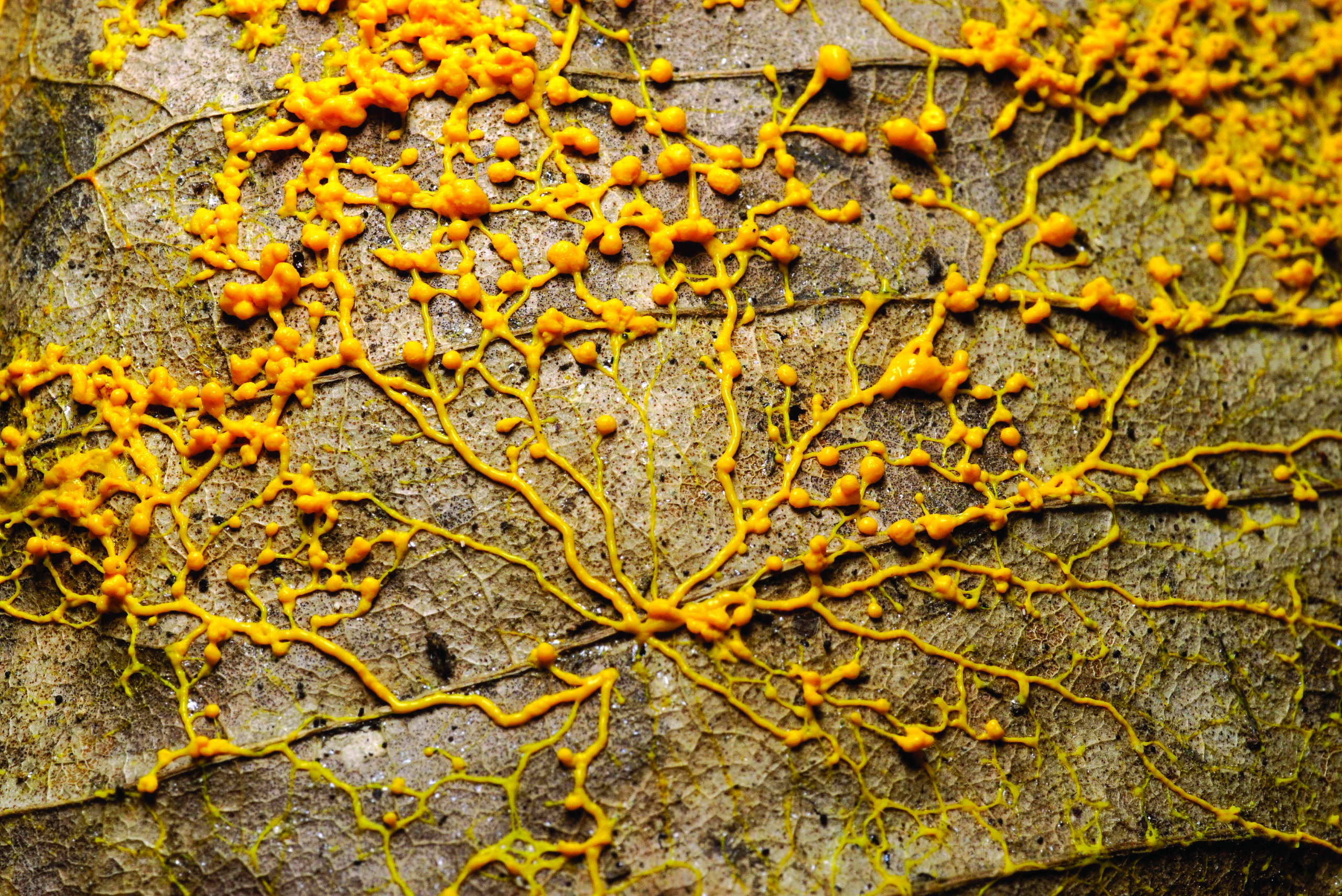
Yellow slime mold on fallen leaf. Photo by Yamaoyaji
AJ 30
NATURAL CURIOSITIES
The Mold That Ate Tokyo
How the lowly slime mold can rival our best transit engineers
The mold was first concentrated in the very heart of Tokyo. It was a slime mold, Physarum polycephalum, a viscous yellow blob, with crisscrossing veins running beneath its mucousy skin. Soon after it appeared, the mold sprouted curling tendrils reaching hungrily for the most populated sections of the city. Within a day, it had spread outward to devour regional towns orbiting Tokyo’s urban center, consuming any nutrients it found. Scientists watched, baffled. But they were also gleeful. They weren’t observing a mold eating the real Tokyo, but a scattering of tiny oat flakes in a Petri dish laid out in a pattern representing Tokyo’s metro area.
Slime molds have been studied extensively for decades and scientists knew they could navigate mazes in pursuit of food. They’d also learned molds could locate a nutrient source and remember where it was, and they’d discovered molds could share that beta with other slime molds. Inspired by this, biologist Toshiyuki Nakagaki of Hokkaido University built a
500 words to go
You’re just getting to the good part.
This story — and 42 issues of them — opens with a subscription.
Either one picks up right where you left off.
Join 7,000+ readers · Independently owned · Since 2008
Already a subscriber? Sign in
Adventure Journal — Print Quarterly
Stories like this, in your hands four times a year.
42 issues. 11 years. Independently owned. Printed on 70lb uncoated paper with a soft-touch cover, solar-powered, and shipped in a brown paper envelope. Free domestic shipping.