Mementos, Notes, and Fragments
Sorry, Tim, But You Weren’t the First
In 1891, the Swiss Army adopted a new rifle called the Schmidt-Rubin Model 1899, which led to the popularization of a contraption you almost certainly own today—the multitool. The rifle required a screwdriver for disassembly and cleaning, so the Swiss Army awarded a contract to an engineer named Karl Elsener to produce a folding pocket knife for its soldiers that included a screwdriver in addition to a blade, can opener, and reamer. Elsener’s design was a smashing success (as was his business, which he eventually renamed Victorinox), and the legendary Swiss Army Knife was born.
Elsener’s tool was easy to use and relatively uncomplicated to manufacture, and it soon spread far beyond the kit of Swiss infantry to become the ubiquitous gift for outdoor enthusiast kids everywhere. But it was by no means the first multitool.
Herman Melville’s 1851 novel Moby Dick references a carpenter’s pocket tool called a Sheffield Contrivance, bristling with “not only blades of various sizes, but also screwdrivers, cork-screws, tweezers, awls, pens, rulers, nail-filers, countersinkers.” Tools like this weren’t terribly difficult to find in nineteenth-century England. Carpenters might hold one containing rulers and wire gauges. The well-manicured man could buy multitools containing buttonhooks, mustache combs, and, ew, earwax spoons. Multitools containing as many as seventy-five different knife blades weren’t unheard of in country estates, an unwieldy and braggy show of wealth. Yet the multitool goes back even further.
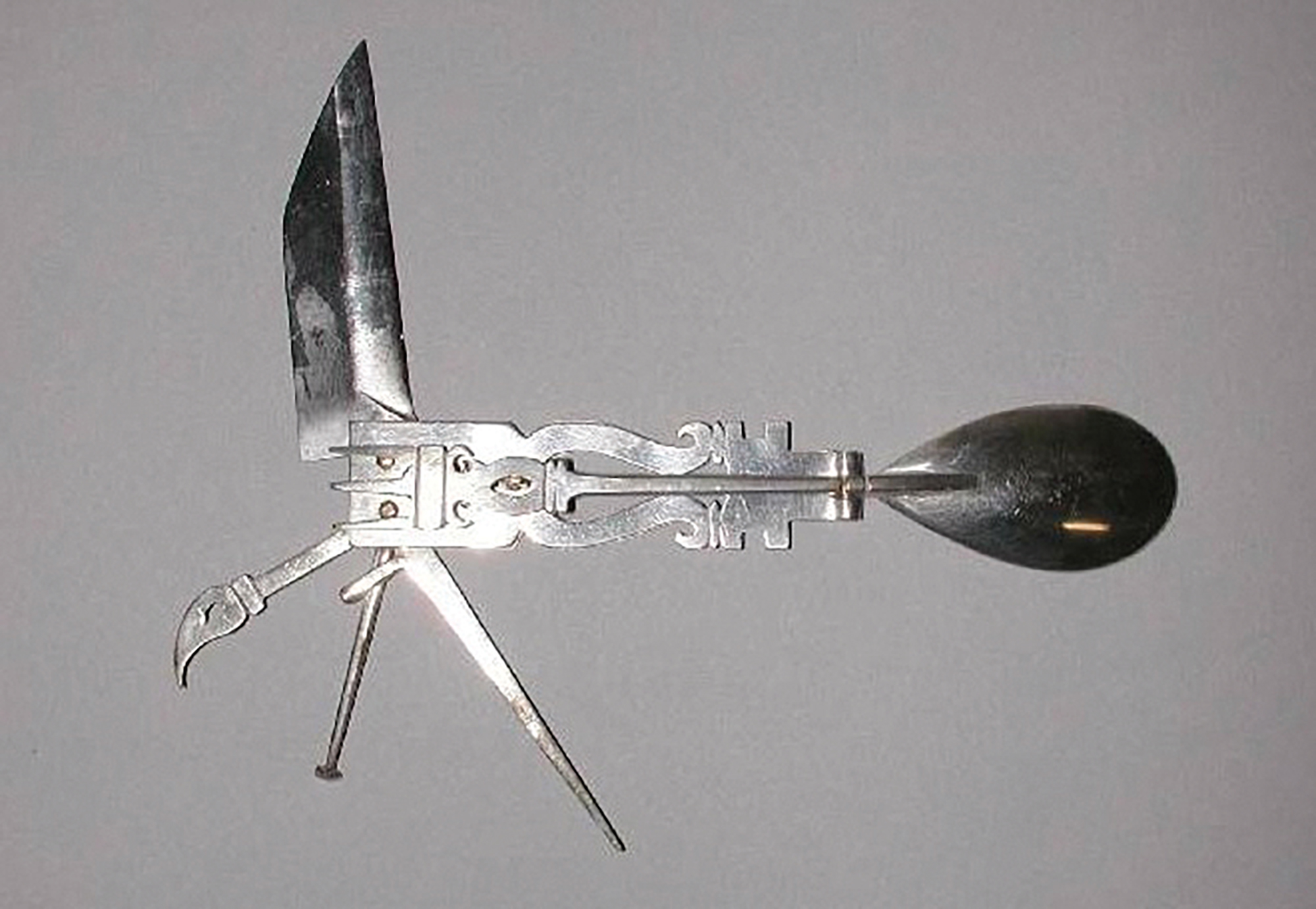
An ancient Roman example was discovered at a Mediterranean excavation in the 1990s that was made at least eighteen hundred years before Tim Leatherman even thought of putting a set of pliers in a folding pocketknife. It’s a contraption made from silver and iron containing a blade, pick, spike, fork, and spatula, which folded on a hinge, plus a fixed spoon. One has to assume the owner of the tool, like most multitool owners today, used the knife, and maybe the spike, but otherwise wondered when they’d ever get around to using the rest of the tiny, intricate little implements.
The Rescue in Devil’s Canyon
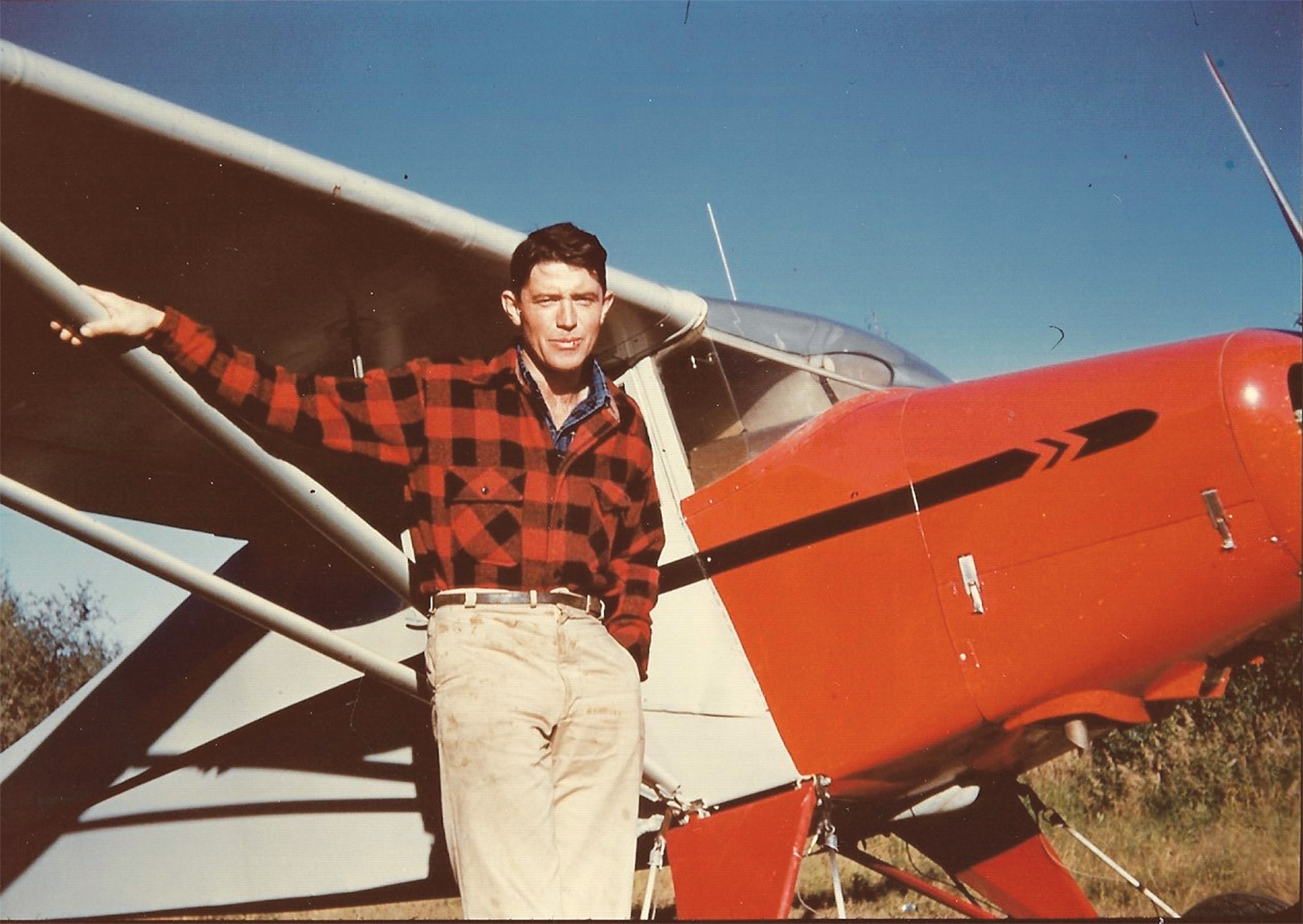
Alaskan bush pilot Don Sheldon’s legend was created one daring flight after another, and few were more daring than his 1958 search and rescue of U.S. Army scouts charting the Susitna River, including the five-mile Devil’s Canyon, which is fraught with rapids and narrows to fifty yards between walls six hundred feet deep. The river was running high with snowmelt that year, and when the train from Anchorage arrived in Talkeetna and disgorged the scouts and their fifty-foot, twin-engine boat, Sheldon was skeptical. “Lookee,” he told the lieutenant, “I’ve got a heck of a lot of fishing traffic up that way in the next few days, and I’ll check on your progress from time to time.”
It was a good thing he did. Two days later, he flew over the canyon and spied wreckage. “I saw barrels of gasoline bobbing around here and there,” Sheldon said. “The wreckage was strewn downriver to a point almost twenty-five miles below the canyon, and it consisted mostly of bright yellow chunks of the boat’s hull and other debris, but no people.” A short distance up-canyon, he found the crew. “They were in a terrible condition, cut up, and barely managing to cling to the shelf of rock. Their clothing was literally torn off, and a few of them still had life jackets on. These were also in shreds. They had apparently floated down about sixty percent of the canyon, a distance of about three miles.”
Sheldon had few options. He chose, perhaps, his only one: Landing his float plane on the one small section of smooth water above the rapids. Which he did, the plane bucking in the turbulent canyon air. And then—wait for it—he floated backward through the rapids and their six-foot standing waves to the crew. “After spotting the men, I had to stop the airplane’s backward motion, which I did with full throttle, but I knew my problems had only begun. I had to get the airplane close enough to the ledge for the guys to jump out onto the float and get aboard without damaging a wing on the rocks. If they missed, in their condition, they’d drown for sure.
“Because of the heavy current and extremely rough water, it was impossible for me to taxi upriver, let alone take off in that direction, so all I could do was continue to float backward as I had been doing. It was a mile and a half downstream to the end of the rapids, and that first trip was one of the longest rides on a river that I’ve ever taken.”
That’s right, Don Sheldon ran the Devil’s Canyon. In a float plane. Backward. And he did it three more times. He rescued the last G.I. eighteen miles below the canyon, where he’d been swept. Thanks to Sheldon, all the men survived.

Supernatural Fabrications
Metal held an early fascination for Japanese-born artist Mariko Kusumoto, who grew up in a four-hundred-year-old Buddhist temple, where her father was a priest. She was enchanted by the metal ornaments on the altar—one of her chores was to polish them—and when she took a photo-etching class in college, she was captivated more by the metal plates than the pictures they created on paper. For the first eighteen years of her fine art career, this was her focus: finely detailed tableaux, boxes, dolls, and small cabinets of curiosities that resembled ornaments themselves—albeit gothic-steampunk-pachinko ornaments.
In 2013, now based in Boston, Kusumoto turned her attention to a dramatically different material, fabric, something “abstract and organic,” and the result is artwork that mirrors the astounding diversity and beauty of undersea organisms, such as corals, diatoms, plants, sponges, and more, but almost always with a twist—unexpected colors, a slight geometry to the shape. It’s whimsical, playful, and seemingly alive, like species from a newly discovered and lighthearted planetary cousin. Sometimes she makes sculptures or objects, but often it’s jewelry. One of her necklaces is in the permanent collection at London’s Victoria & Albert Museum, another is in the collection at the Smithsonian American Art Museum.
“I develop fabric pieces that reflect my strong interest in the material itself. Fabric is inherently the opposite of metal,” Kusumoto told My Modern Met. “I strive to bring out the fabric’s inherent characteristics and beauty. By using a proprietary heat-setting technique, I give it a new identity by reshaping it into three-dimensional forms. Because I love the translucency of fabric, through working with layers and adding or moving parts, I can create playful, mysterious, and ethereal atmospheres.”
The Chilkoot Makes Everest Look Empty
Gold fever hit the Klondike in Canada’s Yukon Province in 1896 and by the time it petered out in 1899, an estimated one hundred thousand miners had sought their fortunes in the dirt, most failing. Before they could swing a pick, though, they had to cross the Coast Mountains from Alaska, and many ascended the 3,575-foot Chilkoot Pass on the border.
Canadian officials required “stampeders,” as the prospectors were known, to bring one ton of goods with them, in hopes they could survive the frontier. This included a year’s supply of food, which totaled half the weight, as well as another thousand pounds of equipment. The suggested clothing list included two wool blankets, two pairs of heavy mackinaw trousers, one rubber-lined coat, six pairs of wool socks, two flannel overshirts, three suits of heavy underwear, and six pairs of mittens. Equipment included twenty pounds of nails, a medicine cabinet, and a gold pan. The suggested food included four hundred pounds of flour, one hundred fifty pounds of bacon, and (just) ten pounds of coffee.
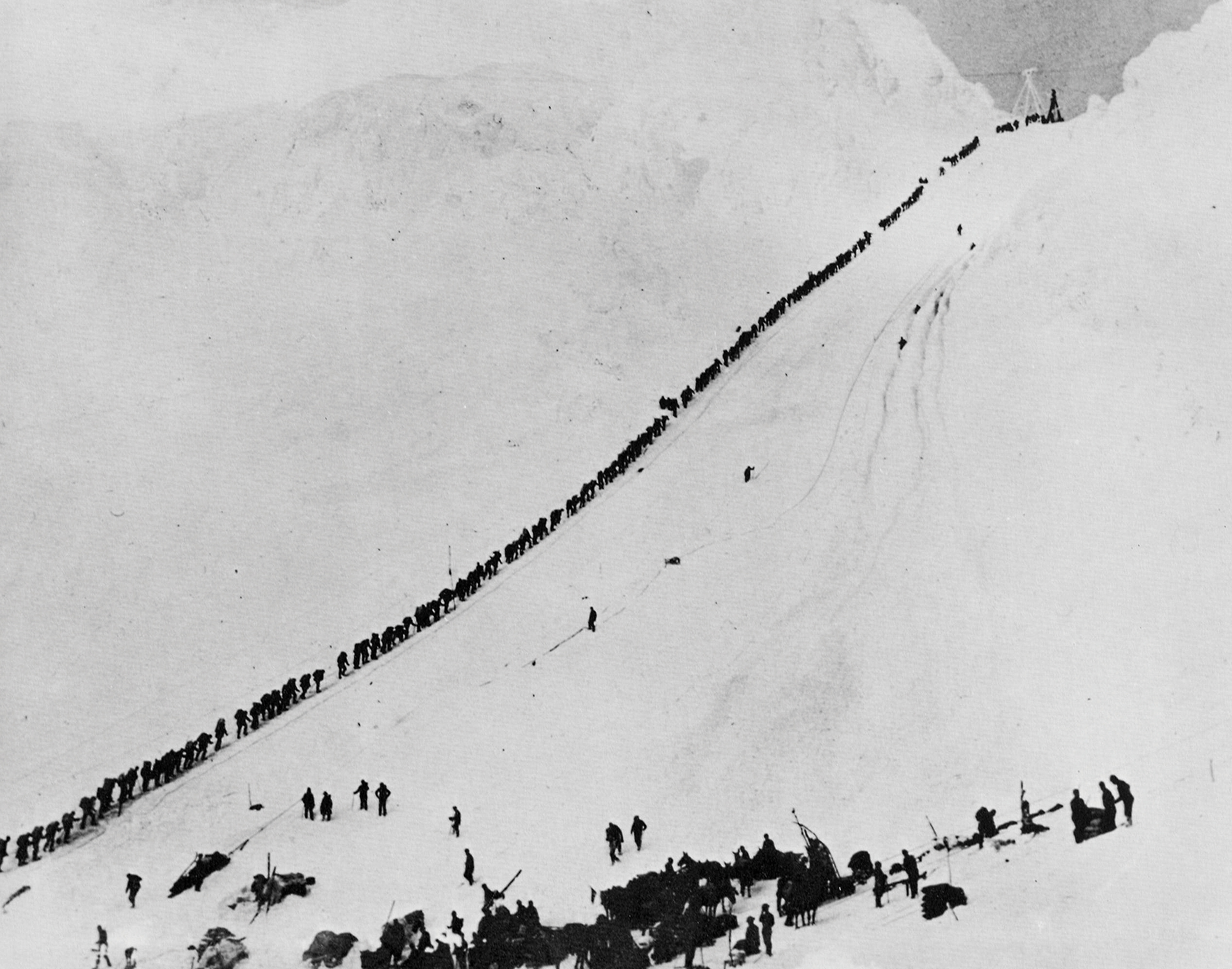
Miners typically carried fifty pounds on their backs each trip up Chilkoot. The trail rose nine hundred feet to the base of the pass, an area called the Scales, which was the last place miners could have their provisions weighed and where they could stash them until their next ascent. From there, it was another six hundred feet over the top, across sharp slabs of rock, which made footing treacherous and often induced crawling during summer months. In winter, workers cut the ice and snow into fifteen hundred steps, known as the Golden Stairs. These were too narrow for more than one person at a time, so the trek was limited to a single-file line up the mountain.
Yep, it was good times on Chilkoot Pass, captured succinctly by Jack London in his 1910 novel, Burning Daylight: “I went out over the Pass in a fall blizzard, with a rag of a shirt and a cup of raw flour. I got my grub-stake in Juneau that winter, and in the spring I went over the Pass once more. And once more the famine drew me out. Next spring I went in again, and I swore then that I’d never come out till I made my stake. Well, I ain’t made it, and here I am.”
42 issues. 11 years. Independently owned. Printed on 70lb uncoated paper with a soft-touch cover, solar-powered, and shipped in a brown paper envelope. Free domestic shipping.