Mementos, Notes, and Fragments
The Buck and Its Rack Stop Here
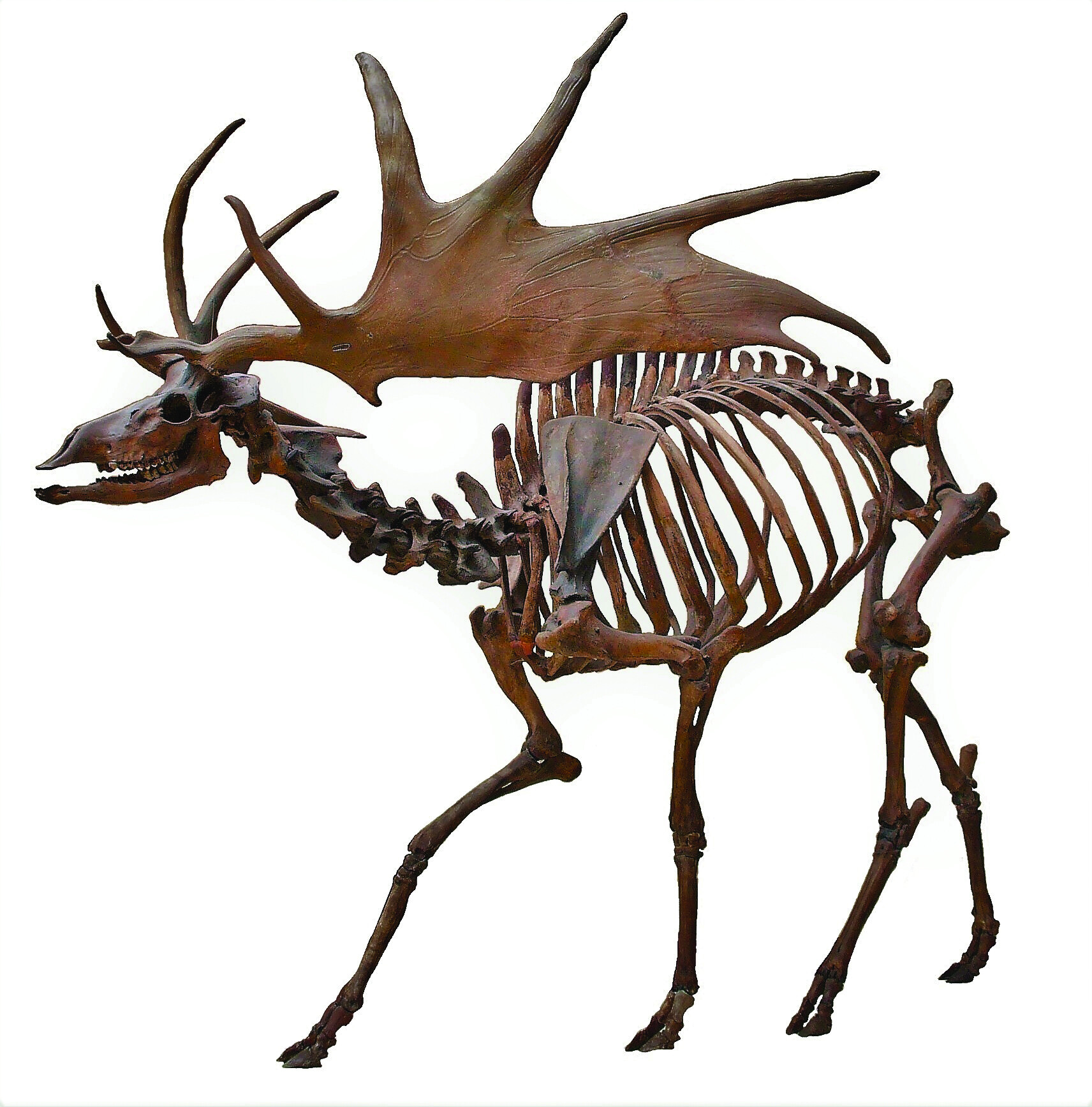
Picture the biggest deer you’ve ever seen, double it in size, and plant comically large antlers on its head. Whatever you’re imagining, the prehistoric Megaloceros giganteus, commonly called the Irish elk, was probably even bigger than that. Not really Irish, as it roamed from the British Isles to Siberia and down to northern Asia, and definitely not an elk, M. giganteus was roughly the size of an Alaskan moose and was the biggest deer species ever to live. It went extinct eight thousand years ago, its last herd dying out somewhere in what would become Russia.
Irish peasants digging into peat bogs began encountering the fossilized remains of this ginormous deer in the 1500s. They were freaked out by those antlers—the stuff, perhaps, of peasant legend and nightmare. Only males had them and, at twelve feet across and weighing nearly one hundred pounds, they were the largest antlers of any known animal. But what purpose did they serve?
Until recently, biologists disagreed. A couple hundred years ago, M. giganteus‘s big honkers were thought to have been the cause of its demise; the antlers were so big and heavy they drowned the poor beasts in bogs—an evolutionary and watery dead end. Later scientists surmised they were solely for show, like a peacock’s swaggy tail. But recent research revealed markings and scratches on the antlers, indicating the giant deer used them as weapons to claim mates, locking heads with rivals during the fall rutting season to establish dominance. The bigger the antlers, the more likely they were to defeat usurpers to their harem, the more likely they were to pass on their genes for big antlers, and on and on until those racks became the size of a Buick. The better to woo you with, my, um, deer.

The Longest Sits in the History of Sits
Ever hike into an alpine meadow on your way to a peak only to be gobsmacked by a view so beautiful you abandon your plans for a summit and sit there and do nothing but stare? Yeah, us neither.
Robert Silk, however, is trying to pioneer the “endurance sport” of extreme sitting. He is the founder of the International Extreme Sitting Association and also the International Desert Sitting Association and to this date the only member of both. A funny quest? Let’s call it humorous. That said, you try hanging out in a spectacular wilderness setting doing nothing but sitting for as long as possible. Watching the clouds move through the sky, the light deepening in tones across the faces of mountains, the trees bending one way, then the next as the wind direction shifts in the afternoon. No watch, no electronic devices. Just observing, perching, and perhaps reminding yourself aloud how extreme you are.
Okay, Silk’s passion is more meditation than sport. “The idea,” he says, “is to really just be, and not do much of anything.” It’s harder than it sounds: His first sit lasted just three hours. It’s taken him years to work up to a full day.
This is a bit of a gag, yes, but Silk became enamored of the idea of slowing down in deep contemplation in 1995—long before the attention-deficit era of social media—when he read the novel The Haj by Leon Uris and discovered a world where “time is of no consequence.” Curious to find zen in slowing down, he since then has sat in spots across the Southwest. In June 2020, he sat for fourteen hours and twenty-seven minutes in California’s Joshua Tree National Park, a personal record. In February 2022, he plopped down in another desert, Antarctica, for his coldest repose thus far. “When you’re doing full-day sits,” says Silk, “the sun, cold, or wind might start getting to you. Just remember that this is an extreme outdoor sport and dealing with physical discomfort is part of being an endurance athlete.”
When They Go High, Some Go Low
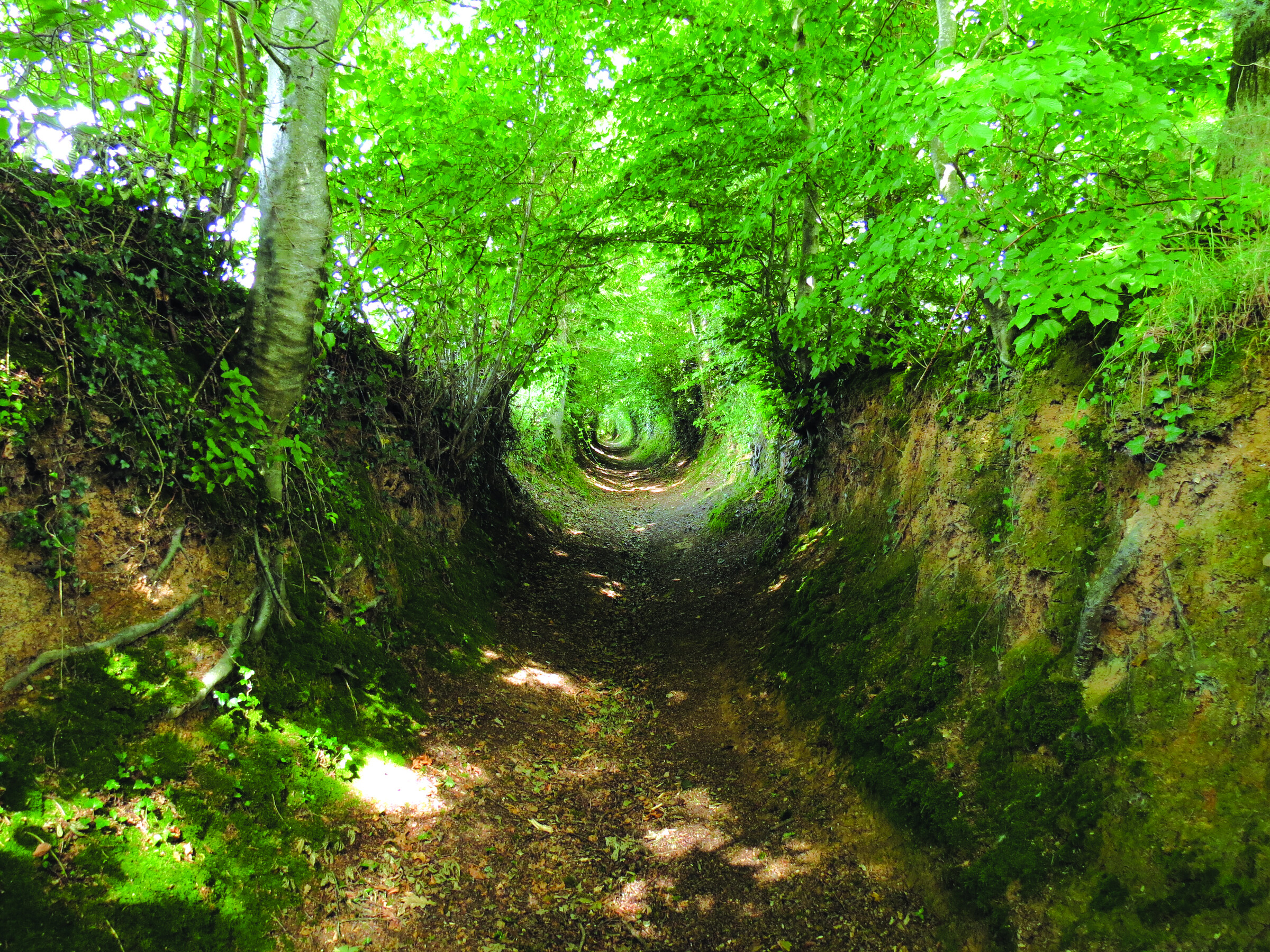
In low-lying northern Europe, there’s a network of wilderness paths more tunnel-like than trail-like. Often started by the flow of running water, these trails were worn deeper by feet and hooves that cut grooves through soil and soft stone, then were eroded further by rain and snow until the bathtub-shaped paths have sunk up to twenty feet below the surface. Tree canopies now form cathedralesque roofs, giving the appearance of having been bored by some ancient, steam-chugging machinery.
In England, the paths are called bostels, grundles, or shutes; in Belgium, holle weg. Most commonly, they are known as holloways. Some date back three thousand years, others merely from the eighteenth century. In most cases, they’re too deep to be filled and too narrow for cars, and nature has bordered them with greenery and populated them with critters that long ago abandoned the increasingly industrialized surface. Animals like badgers, stag beetles, tawny owls, and others that exist nowhere else or only in dwindling numbers now thrive in the largely untouched microclimates of the holloways—darker, wetter, quieter.
In a modern Europe with precious few untouched open spaces, these sunken paths often harbor the natural world where otherwise there is modernity, especially in the low countrysides where they’re found. Today, there are maps of hiking and cycling holloway routes, and Belgium hosts pro bike races through some of its holle wegen. Says British nature writer Robert MacFarlane, “It seems to me that these nameless places might in fact be more important than the grander wild lands that for so many years have gripped my imagination.”
The Needle in a Haystack Was a Camera on a Glacier
In July 1937, attempting the first ascent of Canada’s third-highest peak, Mount Lucania, legendary pioneering alpine photographer Brad Washburn and partner Bob Bates were in it from the start. Flown by ski plane from Valdez, Alaska, they landed ten miles from the base, near a supply cache placed in June, to discover “fathomless” slush between six and eight feet deep. “Heavy rainstorms during the last month had riddled the glacier with unseasonal crevasses,” Washburn wrote. “The cache itself was almost surrounded by them.”
Conditions were heinous. The plane was stranded four days before temperatures dropped and solidified the snow. It was impossible to bring the two team members waiting in Valdez, and Washburn and Bates now would attempt Lucania and walk more than a hundred miles across mountains and through the brush back to town.
Their first act was to shed gear to travel lighter. “At the main base camp, we had left everything—tents, clothes, cameras, food all arranged in a neat heap…in one of the saddest parting scenes one could possibly imagine.”
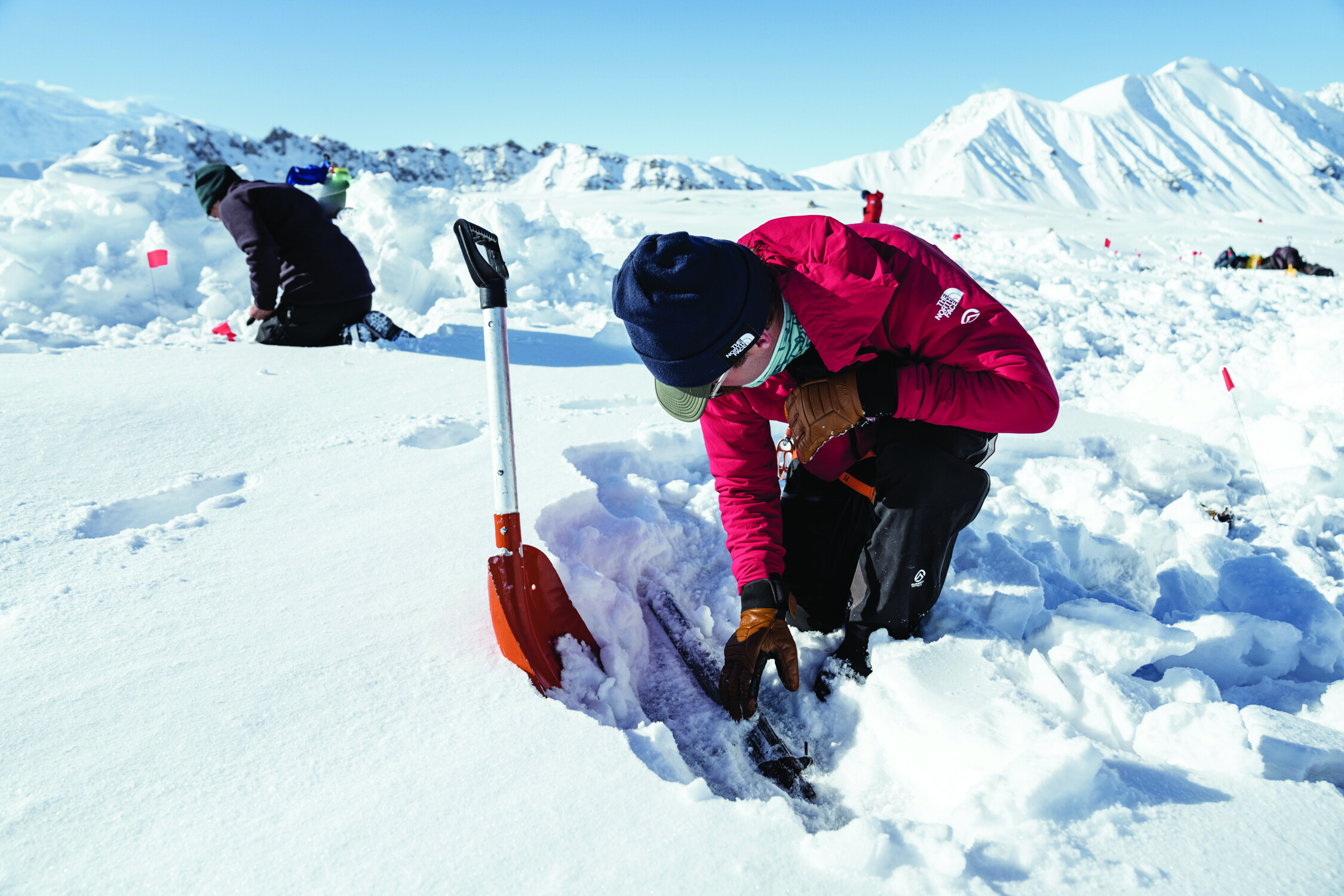
Washburn never returned for his stuff, but eighty-five years later, in 2022, a team led by ski mountaineer Griffin Post and funded by Teton Gravity Research visited the Walsh Glacier in search of the cache. This was no easy task. Typically, the Walsh moves about three feet a day, but twice it’s had surges of more than thirty feet a day. Predicting the location would require a glaciologist—and luck.
The TGR team had both. University of Ottawa’s Dora Medrzycka was on the ice for a week before anomalies in crevasse patterns clued her onto the surges. On an educated guess, the team looked about twelve miles from the original site, and there it was: a pile of 1930s mountaineering gear plus Washburn’s Fairchild F-8 still camera and two motion cameras. A few weeks later, under the aegis of Parks Canada, the cache was retrieved, bringing rare data on glacial movements and the end of a legendary and long climbing odyssey.
42 issues. 11 years. Independently owned. Printed on 70lb uncoated paper with a soft-touch cover, solar-powered, and shipped in a brown paper envelope. Free domestic shipping.