AJ 25 Mementos, Notes, and Fragments
Mementos, Notes, and Fragments

Issue 25
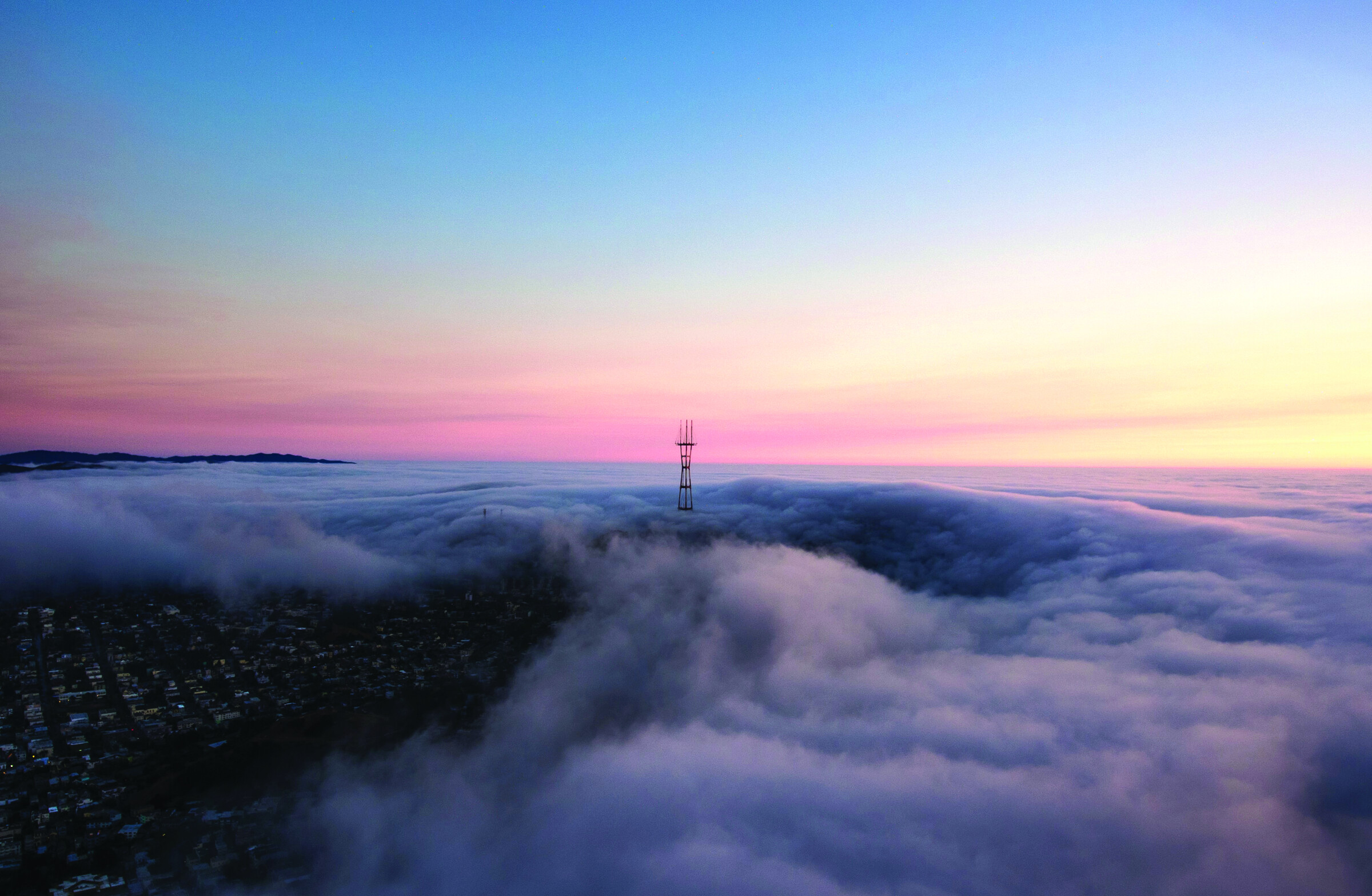
Karl the Fog rolling over San Francisco
01

Good Fog, Karl, Good Fog

The Bay Area’s famous fog has been rolling in from the Pacific Ocean since long before Mark Twain quipped that the coldest winter he ever spent was a summer in San Francisco, and in August 2010 the fog finally revealed it has a name: Karl. Via Twitter, Karl announced that it was, well, Karl. As weather phenomena go, the name lacks the inherent drama of Diablo winds or bomb cyclones or firenadoes, but it’s far more personable (literally, as the kids say). And if Karl identifies as Karl, isn’t that Karl’s right?

The creator behind @KarlTheFog has only acknowledged that the profile was launched in response to parody Twitter accounts like now-deleted British Petroleum Global Public Relations (@BPGlobalPR), which after the Deepwater Horizon oil spill tweeted, “Thousands of people are attacked by sea creatures every year. We at BP are dedicated to bringing that number down. You’re welcome!” Karl’s tweets are more lighthearted, if a bit dad-jokey—but hey, comedy is hard, even when you’re a cloud of condensed water vapor. The creator also revealed that inspiration for the name came from the misunderstood giant in Tim Burton’s Big Fish, which was not a marauding terror but just hungry and lonely.

“Karl” has been accepted by many in San Francisco, except for traditionalists who sniff that fog is just fog, and it even made an appearance in a Jeopardy clue. In 2016, Karl was joined by “Steve,” a glowing stripe of plasma often seen in northern skies by aurora borealis watchers. Steve, which the New York Times called a “charmingly banal” name, was intended to be a place-holder label until a more official designation came along (and, yes, was inspired by the hedge in the movie Over the Hedge). In 2017, designation came: The NASA team studying Steve formally declared it to be STEVE (“Strong Thermal Emission Velocity Enhancement”). On that news, Karl was silent.

Ian Simmonds
Mount Everest
02

Sorry, But You’re Pronouncing ‘Everest’ Wrong

The fun spirit behind Karl the Fog notwithstanding, the naming of something can be serious business, especially when geopolitics and colonialism are at play. In 1849, the British empire was in full expression of its power, and Andrew Waugh, the surveyor general of India, was charged with mapping and naming the mountains of the Himalaya. When it came to Peak XV, he wrote, “But here is a mountain, probably the highest in the world, without any local name that we can discover, or whose native appellation, if it have any, will not very likely be ascertained before we are allowed to penetrate and to approach close to this snowy mass.”

The choice of “penetrate” is telling of the British attitude toward these lands. Nevertheless, Waugh did strive to record traditional names, but in this case, with Tibet and Nepal closed to outsiders, he chose to honor his predecessor as surveyor general, Sir George Everest. Unlike the modern pronunciation “EV-er-est,” Sir George went by “EEV-rist.” Sir George also was adamantly opposed to having his name attached to Peak XV. He firmly believed names should be given by locals. His wishes were ignored. Apparently, knighthood only gets you so far.

Tibetans and Nepalis did have their own names for the mountain, of course, and the Tibetan version was recorded as early as 1721, on a Chinese map, and appeared in Europe in 1733 on a map published in Paris by a cartographer named Jean-Baptiste Bourguignon d’Anville. In Tibetan, the mountain is most commonly spelled Chomolungma, or Qomolangma, and it means “holy mother” or “mother goddess of the world.” The official Nepali name is Sagarmatha, which translates to “goddess of the sky.” George was right all along.

Wikimedia Commons
Osborne fire finder in a lookout tower
03

I Spy, With My Little Osborne Fire Finder…

1910 was a pivotal year in the history of fire in America. Over two days in August, nearly five thousand square miles burned across Idaho, Montana, Washington, and British Columbia. Eighty-seven people were killed and seven towns destroyed. It remains one of the largest wildfires in U.S. history, and the suppress-every-spark policy developed afterward has directly contributed to the massive blazes in the American West today.

The Big Blowup, as it’s known, also led William Osborne, a twenty-five-year-old forester stationed in Oregon National Forest, to spend the winter of 1910–11 in his home workshop creating a rotating, disc-shaped device to help watchers quickly pinpoint the locations of burns or smoke. Now known as the Osborne fire finder, it used two brass sighting mechanisms atop a circular topo map of the forest, with the center of the map on the spotter’s location (typically, a lookout tower). The device was extremely accurate and easy to use, and the fledgling Forest Service put it in service immediately. By 1913, Leupold-Volpel & Company was cranking out commercial versions.

While he never profited from his invention, Osborne continued to improve the finder over his career with the Forest Service, with the 1934 model the pinnacle of design. Even in the era of satellites and remote cameras, it still can be found in fire towers across the country, and not just as an artifact of the past but as a tool that remains accurate, fast, and valuable. In 1975, though, Leupold stopped production, leaving the USFS in a bind, without replacement parts, castings, or even production schematics. Jeff Palmquist, a tooling maker and volunteer lookout in California’s San Bernardino National Forest, came to the rescue, and today Palmquist is the sole manufacturer of Osbornes. A complete unit costs about four thousand dollars.

Dyan Bone / Kaibab National Forest
Mont Aiguille, France
04

The First Send Was By Royal Decree

What the king of France wants, the king of France gets. When Charles VIII, also known as Charles the Affable, caught sight of Mont Aiguille in 1489, the dramatic, thousand-foot pinnacle thirty miles south of Grenoble was shrouded in mystique. Rumor was that angels were seen flying above its flat summit, preventing trespass, and the limestone itself, according to Roman legend, was torn from other peaks when a hunter named Ibicus peeped at naked goddesses on top and was turned into an ibex as punishment.

Such issues were of little concern to the twenty-two-year-old Charles, who in 1492 ordered his chamberlain to assemble a crew and get thee to the summit, quick. How Antoine de Ville, the anointed team leader, felt about his mission was not recorded, but he did bring along two spiritual advisors, as well as a master carpenter, stonemason, and siege-ladder builder. It took them weeks of preparation and then three days of climbing, including “half a league by means of ladders.” On July 26, they topped out.

Team Affable found a herd of chamois, but no angels. They would not descend until their feat was confirmed for the king by the leader of Grenoble, to whom de Ville wrote, “When I left the king he charged me to cause an attempt to be made to see whether it was possible to climb the mountain which was said to be inaccessible; which mountain I, by subtle means and engines, have found the means of climbing, thanks be to God.” Grenoble’s emissary arrived to see ladders at the base of the mountain and de Ville on top, but was too scared to proceed.

The climb of Mont Aiguille is the first documented mountaineering expedition. Typical of many a successful first ascensionist, de Ville’s verdict was mixed. On one hand, he called it “the most horrible and appalling passage that I have ever seen”; on the other, he wrote it was “the most beautiful place that I have ever visited.” As for Charles, he was perhaps too ardent of a sports fan: On his way to watch a tennis match in 1498, he accidentally slammed his head on a door frame, fell into a coma, and died a few hours later.

Wikimedia Commons
Adventure Journal — Print Quarterly
Stories like this, in your hands four times a year.

42 issues. 11 years. Independently owned. Printed on 70lb uncoated paper with a soft-touch cover, solar-powered, and shipped in a brown paper envelope. Free domestic shipping.

Subscribe — $80/year Or try a single issue for $25

There is nothing else like it. — AJ subscriber