AJ 26 Mementos, Notes, and Fragments
Mementos, Notes, and Fragments

Issue 26
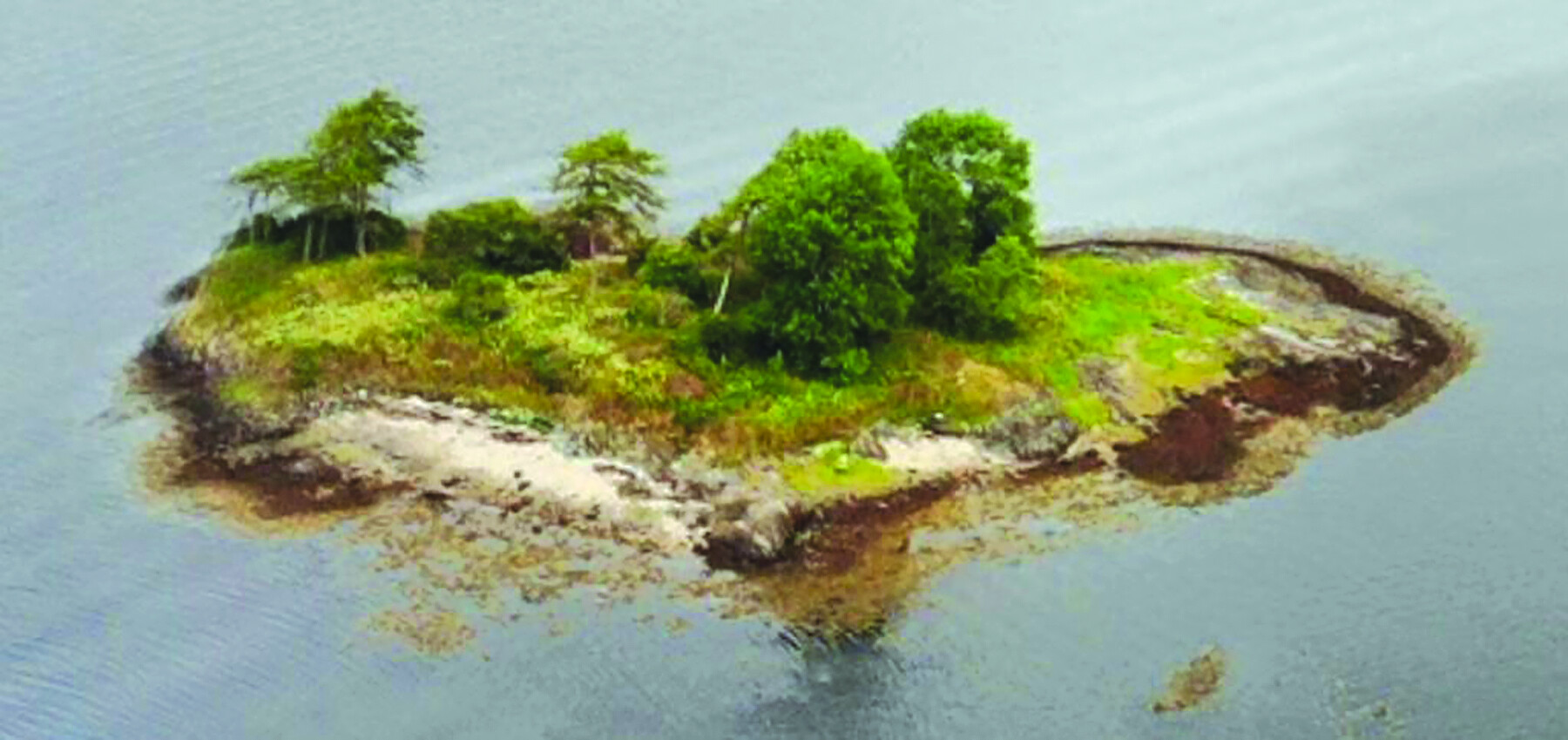
Eilean a' Chòmhraidh, the Isle of Discussion, in Scotland's Loch Leven
01

You Wanna Take This Outside?

It reads like the pilot for a reality show. Two people are in the midst of an intractable argument so bad their friends and family can’t stand it anymore, so they’re dispatched by boat to an uninhabited island in the Scottish Highlands. Along with the feuding parties, the boat delivers a case of whisky, a supply of sweetened oatcakes, and a thick wheel of cheese. Left alone, hungry and crazed, will the quarrelers fight to the death over the supplies? Or will they patch things up?

This isn’t a television pitch. It’s the very real Eilean a’ Chòmhraidh, the Isle of Discussion, a tiny, heart-shaped island perhaps one thousand square feet, bare of structures (though in the thirteenth century it held a tiny castle), in Scotland’s Loch Leven. It’s part of a string of islets, many of which served distinct purposes, some for worship, some for burials—and one for settling disputes.

For generations, bickering members of the MacDonald clan were dispatched to Eilean a’ Chòmhraidh by the clan’s head honcho and left there by themselves. Eventually, they hugged things out. Or at least agreed to not kill each other. The whisky probably ran out first. By the time they were down to cheese and oatcakes, things were already desperate.

Once an amicable truce had been reached, they lit a small fire to signal the newfound peace to the rest of the clan watching from the mainland. To make things official, the parties rowed their boat to another islet nearby, Eilean na Bainne, the Isle of Covenant. There, their agreement was codified and signed. Finally, they were allowed to return to the wary clan.

It’s an elegant solution to a community problem, though one you’d assume had to be abused occasionally. Free whisky and cheese and an uninhabited Scottish Highland lake? Who do we have to fight with?

islandofdiscussion.com
The Endurance with sails raised in the ice
02

Ernest Shackleton, Weakling?

In January 1903, as Robert Falcon Scott and Edward Wilson trudged northward along Antarctica’s Ross Ice Shelf toward an anchored ship they could not see, they grew concerned about the new guy. The dude was twenty-eight-year-old Ernest Shackleton, on his first Antarctic expedition. All three men were tired, but Shackleton was so weak he couldn’t drag a sled and could barely stay on his skis. “He was, obviously, a tremendous character, in many ways physically very powerful,” said Antarctic medical historian Ian Calder of Shackleton during that 1903 trip. “The thing that puzzled me was that he always seemed to be conking out.”

Upon their successful return to England, the British National Antarctic Expedition read Wilson’s notes about Shackleton’s performance and ruled him unfit for further expeditions. Undaunted, Shackleton raised funds to lead his own voyages of exploration. In 1907, he successfully returned to the frozen south, then in 1914 he led the Endurance expedition, whose well-known story of survival placed Shackleton in the pantheon of polar legends.

None of which would have happened had Shackleton not bonked, convincing his superiors he didn’t have the stuff for polar expeditions. Shackleton disagreed (obviously), and he was sure it wasn’t innate weakness but scurvy, though a 2021 paper argued Shackleton most likely suffered from beriberi, a thiamine deficiency typically found in eastern Asia. That malady changed the course of Shackleton’s life. “It was the thiamine deficiency that started him on his path as an independent explorer,” said physician Paul Firth, lead author of the paper. “If he hadn’t had beriberi he wouldn’t have made his own way as a leader.”

Eh, you say scurvy, we say beriberi. Whichever vitamin deficiency got him kicked off the national Antarctic survey team, the twenty-seven men of Endurance he led to safety in 1916 couldn’t have cared less.

Frank Hurley
1960 Tour de France musette bag
03

That’s To Go, S’il Vous Plait

During a brutally hot stage at the 1935 Tour de France, the peloton was greeted by what at first must have seemed a mirage: table after table of ice-cold beers set up along a flat section of the course. Most of the riders stopped to lustily quench their thirst in the shade. Tour rider Julien Moineau rode past temptation, won the stage by an easy fifteen minutes, and hoisted a mug of beer to the riders who crossed the finish line behind him. Turns out, his friends had set up the tables of beer as a distraction, knowing his competition couldn’t resist.

Moineau’s stunt, unsporting as it was, wouldn’t have been out of place in the pre-war tours, as it was still common for riders to stop to refuel with snacks. But in the 1930s, racers began toting small bags with long thin straps—musettes—loaded with food and drink, possibly inspired by the musettes carried into battle by French soldiers in World War I. By the 1950s, special handlers called soigneurs dangled the musettes for riders in designated feed zones. The riders snatched them as they passed, tossing the bag straps over their shoulder, and rummaging through them for a badly needed energy boost. In long-ago races, musettes were filled with whatever the rider wanted, including omelets and small bladders of Chablis.

Nearly a century later, despite carbon bikes bristling with exotic technology, the decidedly low-tech musettes and soigneur handoff are a crucial but dangerous part of every long-distance race, as accidents occur with bunched-up riders all snatching musettes at the same time. “The feed zone is a very dangerous place,” says longtime soigneur Garry Beckett. “Every time you do it, when you feel that bag go out of your hand and you don’t hear metal scraping on the tarmac, you breathe an inner sigh of relief.”

Horton Collection
Ghost tracks at White Sands National Park
04

I Like Sloths, Long Walks in the Swamp, and Paleo Dance Parties

The Utah Test and Training Range is a bone-dry million-acre site used by the U.S. armed forces to test new military equipment. The odds of stumbling upon a few dozen faint footprints left thousands of years ago in a place that big must be infinitesimally small. Even more so when those footprints are “ghost tracks,” depressions in the soil that reveal themselves only when moisture conditions at the surface are just right.

But archaeologists did just that in the summer of 2022, discovering nearly a hundred fossil tracks while driving through the range toward an unrelated dig. The footprints were created twelve thousand years ago when the Utah desert was a vibrant wetland. There are eighty-eight prints from adults, children, and teens. The people were walking in the shallows, perhaps collecting food or simply enjoying themselves in the warm water. Their bare feet pressed into the mud, sand rushed in to fill the depressions, and those patterns were preserved for archaeologists to see eons later.

The tracks are similar to a series found in New Mexico’s White Sands National Park in 2021 that appear to date back twenty-three thousand years, adding evidence that the peopling of the Americas came much earlier than previously thought. Those prints tell stories of folks hunting a giant ground sloth, kids running, and an adult repeatedly picking up and carrying a small child. What seems so ephemeral—footprints in sand, the tracks of ghosts—are proving to be some of the oldest links to the first Americans.

NPS / Daron Duke
Adventure Journal — Print Quarterly
Stories like this, in your hands four times a year.

42 issues. 11 years. Independently owned. Printed on 70lb uncoated paper with a soft-touch cover, solar-powered, and shipped in a brown paper envelope. Free domestic shipping.

Subscribe — $80/year Or try a single issue for $25

There is nothing else like it. — AJ subscriber