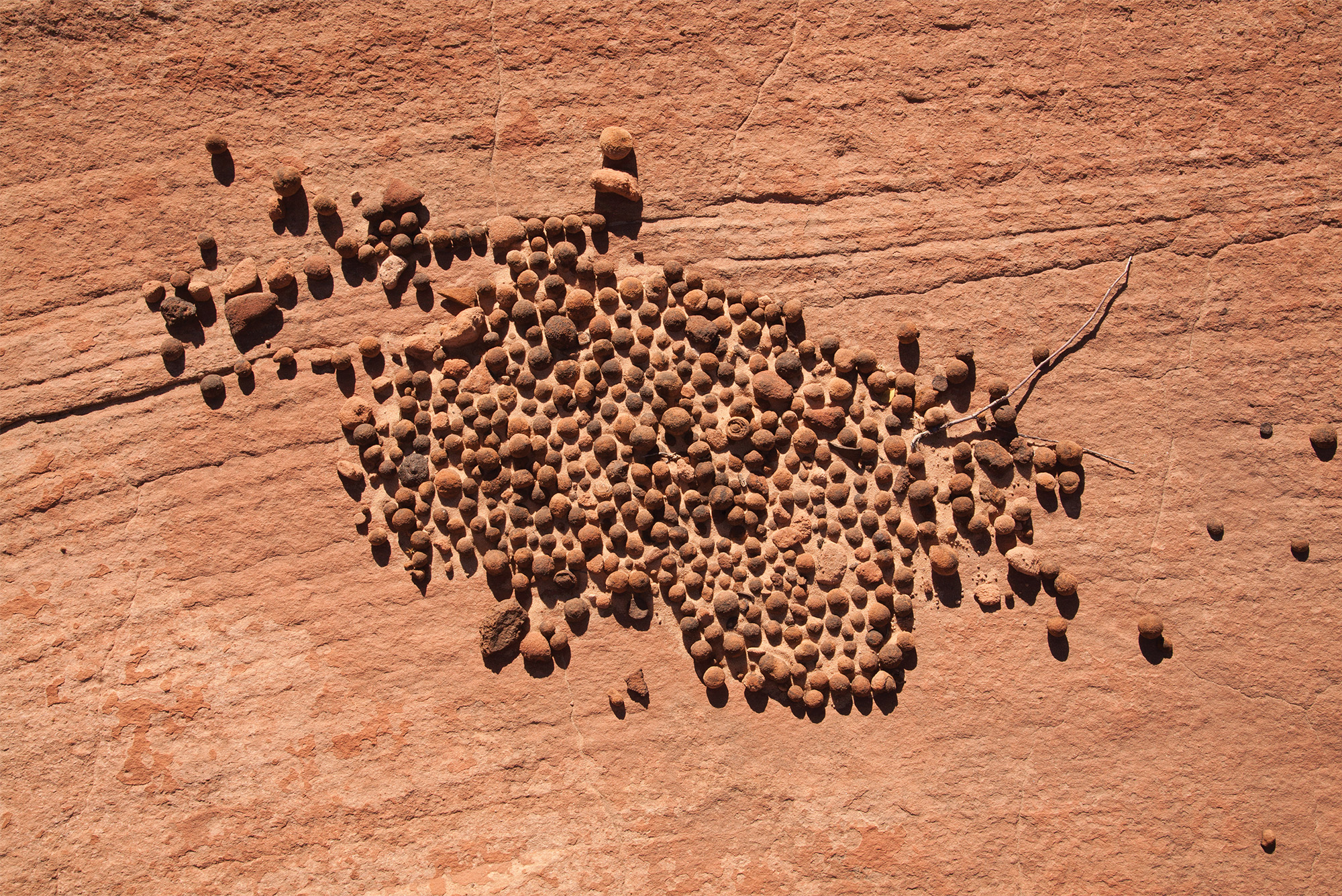
Moqui Marbles
The term 'moqui' is used widely in the American Southwest, but it's when applied to geomorphic oddities that it casts its greatest enchantment
I like to imagine a young Native American man, little older than a boy, really, sitting in the shade of a juniper tree a thousand years ago in what’s now southern Utah, trying to perfect his technique as he knaps flint into arrowheads. From a slope above, there’s a muffled thud, then a dull rattle on sandstone, and then an ebony-brown rock the size of a walnut skitters past and comes to rest in a pothole. The young man doesn’t react—he knows there’s no enemy above, signaling its presence with a kicked stone, nor tasty game to be hunted. It’s just great-grandpa, he thinks, playing games again.
“Moqui,” I was told by a well-traveled desert rat deep in the Escalante backcountry one spring 15 years ago, means “dear departed ones” or “beloved ancestors.” As we stood just a few miles from some of the region’s most popular slot canyons, he gestured to the thousands of rounded rocks scattered in
600 words to go
You’re just getting to the good part.
This story — and 41 issues of them — opens with a subscription.
Either one picks up right where you left off.
Join 7,000+ readers · Independently owned · Since 2008
Already a subscriber? Sign in
Adventure Journal — Print Quarterly
Stories like this, in your hands four times a year.
41 issues. 10 years. Independently owned. Printed on 70lb uncoated paper with a soft-touch cover, solar-powered, and shipped in a brown paper envelope. Free domestic shipping.