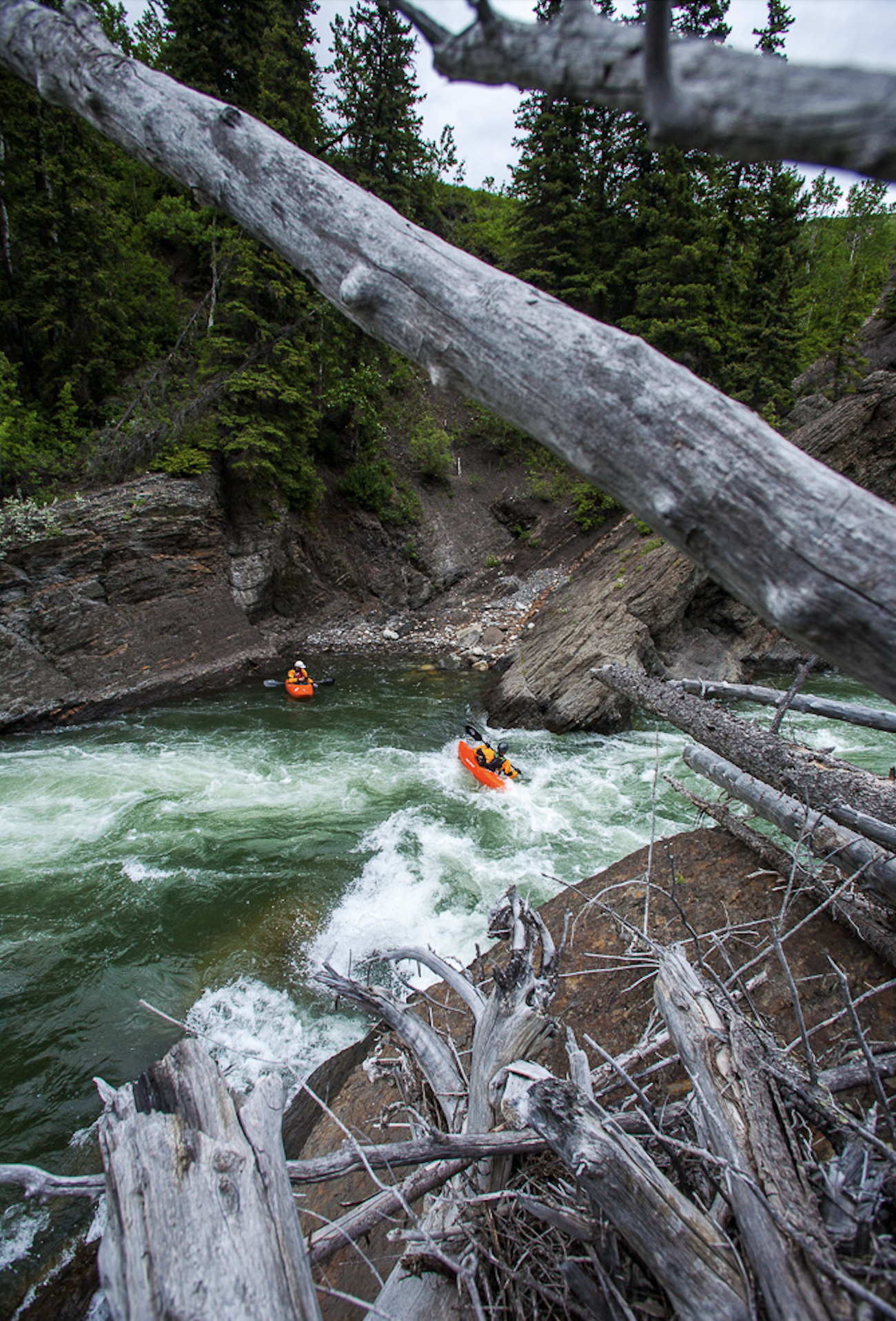
Taking refuge in a river's calm shadow is a critical part of paddling—and a powerful metaphor in life
STORY BY JEFF MOAG
Photo by Ryan Creary
Sixteen centuries ago the Angles, Saxons, and Jutes sailed across the North Sea to Great Britain in oak-planked ships. Naturally they were attuned to the movement of water, and their languages were full of hard consonants and blunt literalisms. The Anglo-Saxon prefix ed-, signifying repetition or returning, produced such pitch-perfect coinages as edniwian “to renew,” edhwierfan “to retrace one’s steps,” and edgeong “to become young again.” All are now lost to the currents of time, save one.
Eddy comes from the Old English ed-, “return” and éa, “water.” That gives us edéa “return water,” which by the fifteenth century had become eddy and claimed the meaning we find in modern dictionaries: a counter-current split off from the mainstream, particularly one that moves in a circular way, as a whirlpool.
River people will find that definition lacking. On whitewater, an eddy is not so much a back current as a refuge, and to eddy out has the connotation of seeking
700 words to go
You’re just getting to the good part.
This story — and 42 issues of them — opens with a subscription.
Stories like this, in your hands four times a year.
42 issues. 11 years. Independently owned. Printed on 70lb uncoated paper with a soft-touch cover, solar-powered, and shipped in a brown paper envelope. Free domestic shipping.