People Changing How We See the World

IF A FREIGHTER STEAMING out of Okinawa takes a big typhoon swell starboard and dumps a container full of Hot Wheels into the Pacific, there are about eleventy billion beaches where those packages of little cars might wash ashore. Ideally for ex-plumber John Anderson, one of them will be along the wind-battered shores of Washington’s Olympic Peninsula, where, if there’s an interesting piece of beach detritus wedged under driftwood or tangled in a clump of rotting seagrass, he will find it. I mean, he has a museum to stock.
It’s John’s Beachcombing Museum, to be precise and to the point. The space formerly was his plumbing shop, but now it serves as the country’s first beachcombing museum. If you enter without noticing the charmingly hand-painted sign on the door, you might think you’ve just walked into an old tackle shop. Buoys and fishing nets adorn the walls, and there are glass cases filled with fishing lures. There are displays of weather-beaten sneakers. And rows and rows of (frankly creepy) Raggedy Ann dolls. There are bottles, bones, and wagon wheels.
Anderson has been a dedicated beachcomber for nearly fifty years. Long before he opened his museum, he stashed his finds wherever he found room, holding on to them for reasons only he could understand. Ask why and you can hear the shrug in his answer: “I’ve always liked interesting things.”
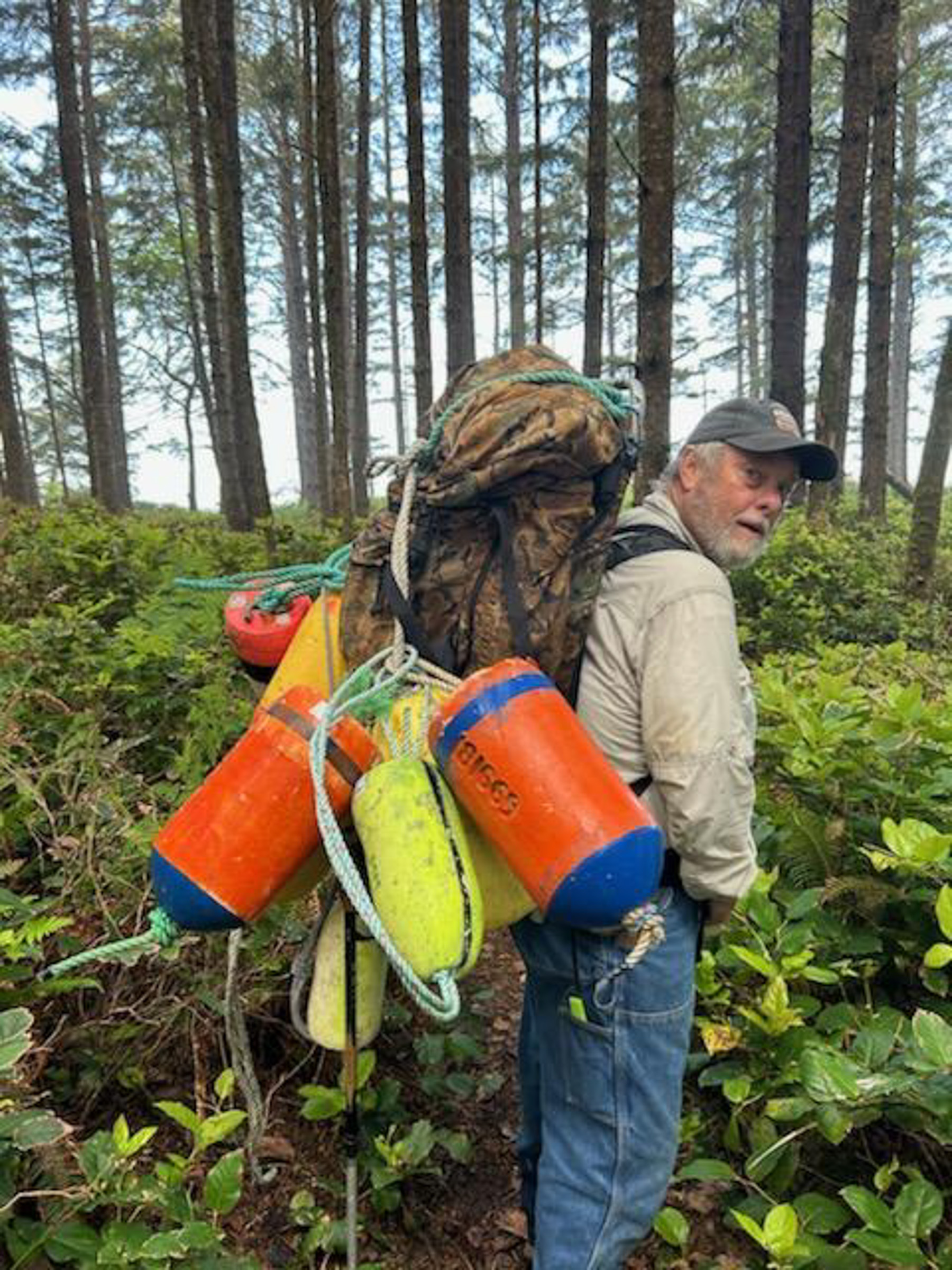
It helps that he lives in a place where currents seem determined to deliver flotsam and the occasional jetsam to his doorstep, though getting to that doorstep often isn’t easy. Anderson calls his practice “extreme beachcombing” because of the effort required: He hikes alone through dense forests to check his preferred honeypots and once spent sixty-two straight hours walking, looking, and filling his pack with treasures. Extreme? Yes. Perhaps that’s what it takes to find the spinner cone from a Boeing 727 engine on your local shore.
Anderson seeks the human connection with everything he lifts from the sand—dolls a little girl played with, timber from a beloved home destroyed by a tsunami. Nowhere is that connection stronger than in the handwritten notes he finds in washed-up bottles and then preserves in binders. If he thinks the sender is still around, he’ll respond to them via post—delivery by a different kind of wind and the tide.


ARTIST JANE KIM’S NEWEST BODY OF WORK, a study of the hidden lives of redwood trees, started with a five-hundred-year-old cookie.
“Cookie” is a forester’s term for a cross-section cut from a tree. Kim’s came from a huge old-growth redwood stump in a forest not far from Silicon Valley, California. As part of a fellowship with Sempervirens Fund, she grabbed a chainsaw and helped cut rounds from the ancient redwood, each a time capsule of droughts, fires, storms, and growth. Kim wanted to tell the stories that are imprinted in those concentric rings like grooves in a giant vinyl record.
Making the hidden visible has long been a theme in her work. She’s best known for her Migrating Mural series that splashed urban walls with vibrant portraits of native animals on the move, including a fifty-foot monarch butterfly in San Francisco. “I wanted to tell stories of the natural world beyond galleries and museums,” Kim said. “To create art in everyday places that connects people with the landscape.”

Kim grew up near Chicago, and her childhood was spent exploring a neighborhood creek and climbing backyard willows. As a Korean American in a predominantly white community, she said she never felt like an outsider as long as she felt immersed in the natural world. Wanting to understand that connection more deeply, she gravitated toward biology in her art.
As the NGO’s inaugural Forest Fellow, Kim dives into redwood ecology alongside foresters, researchers, and naturalists; she even climbed a two-hundred-foot tree to experience the forest from the canopy. The experience became a crash course in the beautiful strangeness of redwoods: fog-drinking trees, underground fungal partnerships, and their reciprocal relationship with oceangoing salmon.

From the cookies, Kim makes large-scale prints of the growth rings of the redwoods, revealing centuries of history buried inside the tree’s core. In one of her paintings, a fire-scarred redwood round erupts with birds, wildlife, and flame-following plants, illustrating how fire, long feared as a destructive force, also creates opportunities for life to thrive in the redwoods. The tree appears not as a solitary giant, but as the hub of a vast living network. Indeed, the deeper Kim ventured into redwood ecology, the more unexpected the discoveries became. “Redwoods actually send out molecules that cause a feeling of stillness,” she said. “It’s like, ‘what the heck?’ Nature is so cool.”
Photos courtesy Jane Kim

IF YOU’VE EVER WATCHED a More Than Just Parks film and thought, I should probably visit that place, you aren’t alone: Millions have viewed these short celebrations of public lands, and that’s exactly the reaction the Pattiz brothers have been trying to provoke for a decade or so.
Jim and Will Pattiz have spent years traveling America’s public lands and creating cinematic love letters to their favorite parks, monuments, and national forests. The brothers fell in love the way so many people do: all at once, their lives forever changed. One day, they crammed into a Prius borrowed from their grandmother and headed west from their Georgia home. They were gobsmacked by what they saw and experienced—summer thunderstorms over deserts, the dazzling night beneath the stars in New Mexico, an ill-advised hike deep into the Grand Canyon that somehow didn’t end in disaster.
They wondered, how many Americans were just like them, people who’d never experienced the places that belonged to everyone? The answer was “a lot,” and their response was making beauty-driven stories about wild America.

Their early years were powered by enthusiasm and suspect financial planning. They spent a month filming Olympic National Park, sleeping in soggy tents and chasing magic sunrises, and emerged with a belief in their ability to advocate for public lands through immersive storytelling. More films followed. Then came a call to partner with the US Forest Service.
Soon they were floating wilderness rivers, filming wildfires, tagging bats in Nevada caves, boating Alaska rivers during the height of the salmon run, and hauling camera gear into some of America’s most spectacular backcountry. Not every encounter went according to plan. Of a black bear they were filming in Grand Teton National Park, Jim said, “The next thing I know, he’s on the bridge with us. He charged, and we ran.”

The work expanded to collaborations with state tourism offices, the National Park Service, and conservation organizations across the country, and More Than Just Parks has become more than just filmmaking. What began as two bootstrapped brothers making videos has evolved into a public lands advocacy organization conducting investigative journalism and policy analysis, and creating tools like a congressional public lands scorecard, threatened public lands map, and an action network. What was once a celebration is now a defense, with the brothers fighting “the fights that matter most right now.”
Photos courtesy More Than Just Parks
42 issues. 11 years. Independently owned. Printed on 70lb uncoated paper with a soft-touch cover, solar-powered, and shipped in a brown paper envelope. Free domestic shipping.