AJ 33 Arts + Sciences

Arts + Sciences

People Changing How We See the World
Kate
Rutherford
Jewelry Maker + Climber Bishop, California
Kate Rutherford
Photo by Mikey Schaefer

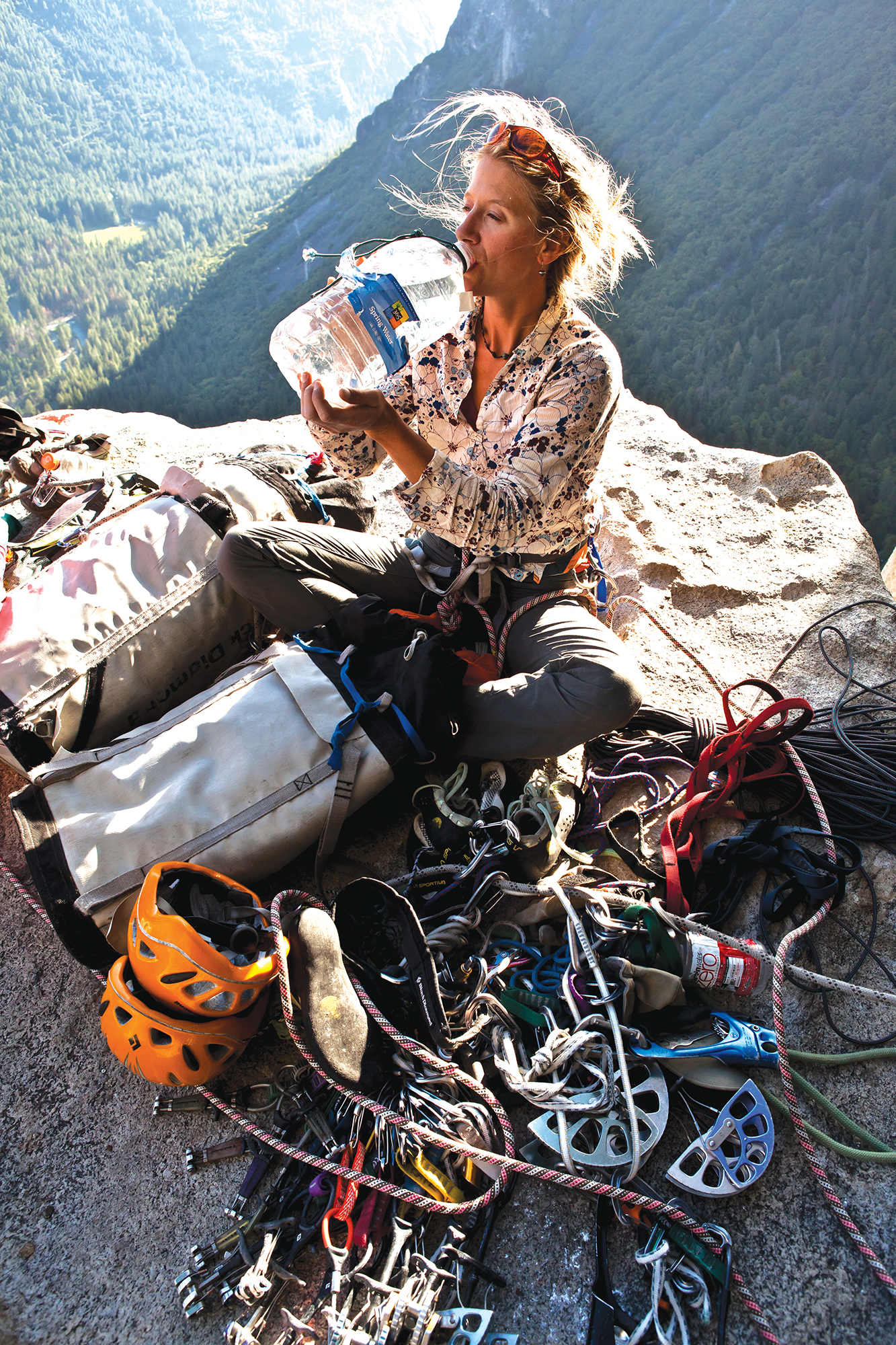
Once a year Kate Rutherford returns to the same remote stretch of beach along the northwest coast of North America (she could tell you where but then she’d have to kill you). She brings an old mesh bag that once contained a Black Diamond climbing harness and fills it with stones she finds in the coarse sand. Rutherford is particular about her matériel so it takes about three days to collect a gallon’s worth. The marble-sized stones are dark, oblong, and polished smooth by an eternity of tumbling around in the surf. “You can actually hear the rocks rolling and grinding beneath the surface when the waves are breaking,” Rutherford says.

Rutherford turns the stones into jewelry, earrings and necklaces composed of several pebbles tied vertically from simple black cord or elegant twists of silver or gold; some look like miniature versions of cairn art you might find next to a river. “There’s an intimacy in each little stone I collect that I also see in rock climbing,” Rutherford says. Oh, right: She’s a world-class professional big-wall climber, too.

Rutherford, who grew up in Alaska, learned to climb while studying biology and art at Colorado College. After school, she moved into her Toyota Tacoma and assumed the life of the dirtbag climber. She started experimenting with making jewelry from stones and textiles joined together—a rumination on being hard and soft at the same time—and sold it from the back of her truck. Fellow climbers were her first customers. Look carefully and today you can spy Rutherford’s jewelry on big climbing names like Lynn Hill and Hazel Findlay. Ever find yourself at the Ansel Adams Gallery in Yosemite Valley? You can buy Rutherford’s jewelry there as well as on her website, Suspended Stones Design.

It makes perfect sense that someone whose life has revolved around pressing her face and body up against huge slabs of rock would have an intimacy with stone. “I have a love for the natural beauty rocks can create,” Rutherford says. “And it just feels good to carry a small piece of the earth around everywhere you go.” In the same way there are rock faces she hasn’t yet climbed, there are, even now, ancient stones dotted here and there on her favorite beach, waiting to be collected in her little mesh bag.

Rutherford chooses simple, rugged black cord for necklaces
Rutherford chooses simple, rugged black cord for necklaces because its simplicity won’t detract from the stones’ beauty.
Think it's easy to find matching stones for earrings? Think again.
Think it’s easy to find matching stones for earrings? Think again.
Rutherford and a different kind of rock art
Kate Rutherford jewelry

Photos by Ben Moon, Kate Rutherford, Eric Bissell, Bernd Zeugswetter

Last Great ReadThe Soil Will Save Us, by Kristin Ohlson
Last Great Listen“Sodade” by Publish the Quest
Last Great WatchThe Biggest Little Farm, written by Mark Monroe and John Chester, directed by John Chester
Russell
Crotty
Visual Artist Ojai, California
Russell Crotty
Photo by Laura Gruenther

Dig through any school-age surfer’s backpack and you’ll find a battered notebook filled with doodles of impossibly perfect waves where their math homework should be. For most surfers, those sketches are just daydreams manifested on paper, a little escape from the humdrum meant for their eyes only. Their drawings don’t normally end up in posh gallery shows to be sold by big-time art dealers. But then again, most surfers don’t sketch like Russell Crotty.

Crotty, a visual artist who lives in Ojai, California, and keeps a studio in Ventura, is known for producing giant, gridded images of tiny surfers swooping around wave faces rippling across the paper with suggested motion. He sketches the surfers with a blue ballpoint pen you might use to scribble down a grocery list. To a non-surfer, Crotty’s work probably looks abstract. To someone who’s spent a lifetime riding waves, like Crotty, the surfers he draws turn into tiny avatars of their favorite riders or even of the viewers themselves, the miniature surfers performing your wildest surfing fantasies.

Crotty grew up riding waves in Bolinas, a funky Northern California beach town, the son of a sculptor who encouraged his artsy side. When complications from diabetes confined Crotty to home for a few years during adolescence, he escaped by “doodling little stick figures surfing and getting really obsessive about it,” he says. That doodling led to art school in San Francisco, then an MFA at UC Irvine, where his professors took away his ballpoint pens and tried to handcuff Crotty to a paintbrush in a bid to make him a classical artist. It didn’t work.

By the 1990s, Crotty was showing his surf sketches at respected spaces around Los Angeles, but was nervous about it. “I thought I’d be laughed out of L.A.,” Crotty says, “because at that time I didn’t think the art world would be receptive to my kind of art.” Tastes were changing, however, and divisions between high brow and low were being dismantled.

In recent years, Crotty has become well-known for his astronomy and cartography, and added bouldering to his repertoire of outdoor fun skills. But he’s still producing his sweeping surf sketches for surf art exhibitions. And he still keeps a small notebook in the car so when he sees a wave that inspires, or even a boulder, he can get to work making the same doodles he has since he was a kid.

Do the Pure Thing
“Do the Pure Thing”
Lefts and Rights
“Lefts and Rights”
Bigfoot Country
“Bigfoot Country”
Carving Left
“Carving Left”

Photos by Russell Crotty

Last Great ReadThe Three-Body Problem, by Liu Cixin
Last Great Listen“Magnolia” by Dylan Mattingly
Last Great WatchA YouTube documentary about the University of Arizona’s Lunar and Planetary Laboratory
Perrin
Ireland
Science Communicator Brooklyn, New York
Perrin Ireland
Photo by Karene Scanterbury Jack

Have you ever thought about how when an animal goes extinct, so does the way that animal had sex? Did you first hear about sexual extinction from a short-haired, blonde, hula-hooping woman on Instagram? If so, you must be a fan of Perrin Ireland, the best—okay, only—hula-hooping, sex-lives-of-animals-loving, science communication artist on the internet.

Ireland has made a career of visually explaining the often unexplainable aspects of science. While a biology undergraduate at Brown, she learned she was more interested in making art about science than she was prodding jellyfish embryos under a microscope. That realization led to illustration gigs at magazines like Discover and Nature and a job at the Natural Resources Defense Council, where for ten years she helped de-wonkify wonky environmental issues. “We focused on how to get people engaged out of a love of place, community, and animals,” she said, “by being super playful and fun in our storytelling.”

Which leads to the hula-hooping. Ireland learned the art as part of a team-building exercise while working as a facilitator. During the pandemic, Ireland made a video for Instagram where she hula-hooped and explained how researchers figured out octopuses can dream. An audience immediately followed.

Her hula-hooping videos are hypnotic. Ireland gyrates and spins the hoop at an expert level while lecturing with a deadpan delivery about how male echidnas have a four-pronged penis or the way female frogs in Panama pick the most attractive mates. Before you know it, you’ve watched five of her clips back to back and now know more about animal boot-knocking habits than you once thought possible.

Ireland is deeply concerned about habitat loss and species extinction, and she’s found a way to share why these places and creatures matter with a zest and moxie no lab has matched. She’s also writing a book called Poking the Squid (about the sex lives of animals, natch), illustrating a zoological newsletter, and maintaining a Substack column—all proof that if you want to garner support for environmental policy goals, you’ll catch more flies with honey. Or sex. And a hula hoop.

Panel from The Most Manly Nature, a watercolor comic about gay dolphins
Panel from “The Most Manly Nature,” a watercolor comic about gay dolphins.
Animal Lovers, Part 01, gouache on paper
“Animal Lovers,” Part 01, gouache on paper.
Animal Lovers, Part 02, gouache on paper
“Animal Lovers,” Part 02, gouache on paper.
Suicidal Sex, mixed media on paper, from the Sex Lives of Animals series
“Suicidal Sex,” mixed media on paper, from the Sex Lives of Animals series.
Long-Term Partners, mixed media on paper, from the Sex Lives of Animals series
“Long-Term Partners,” mixed media on paper, from the Sex Lives of Animals series.

Photos by Garrett Carroll

Last Great ReadThe Quickening, by Elizabeth Rush
Last Great Listen“Extraordinary Machine” by Fiona Apple
Last Great WatchLove Has Won: The Cult of the Mother God, directed by Hannah Olson
Adventure Journal — Print Quarterly
Stories like this, in your hands four times a year.

41 issues. 10 years. Independently owned. Printed on 70lb uncoated paper with a soft-touch cover, solar-powered, and shipped in a brown paper envelope. Free domestic shipping.

Subscribe — $80/year Or try a single issue for $25

There is nothing else like it. — AJ subscriber