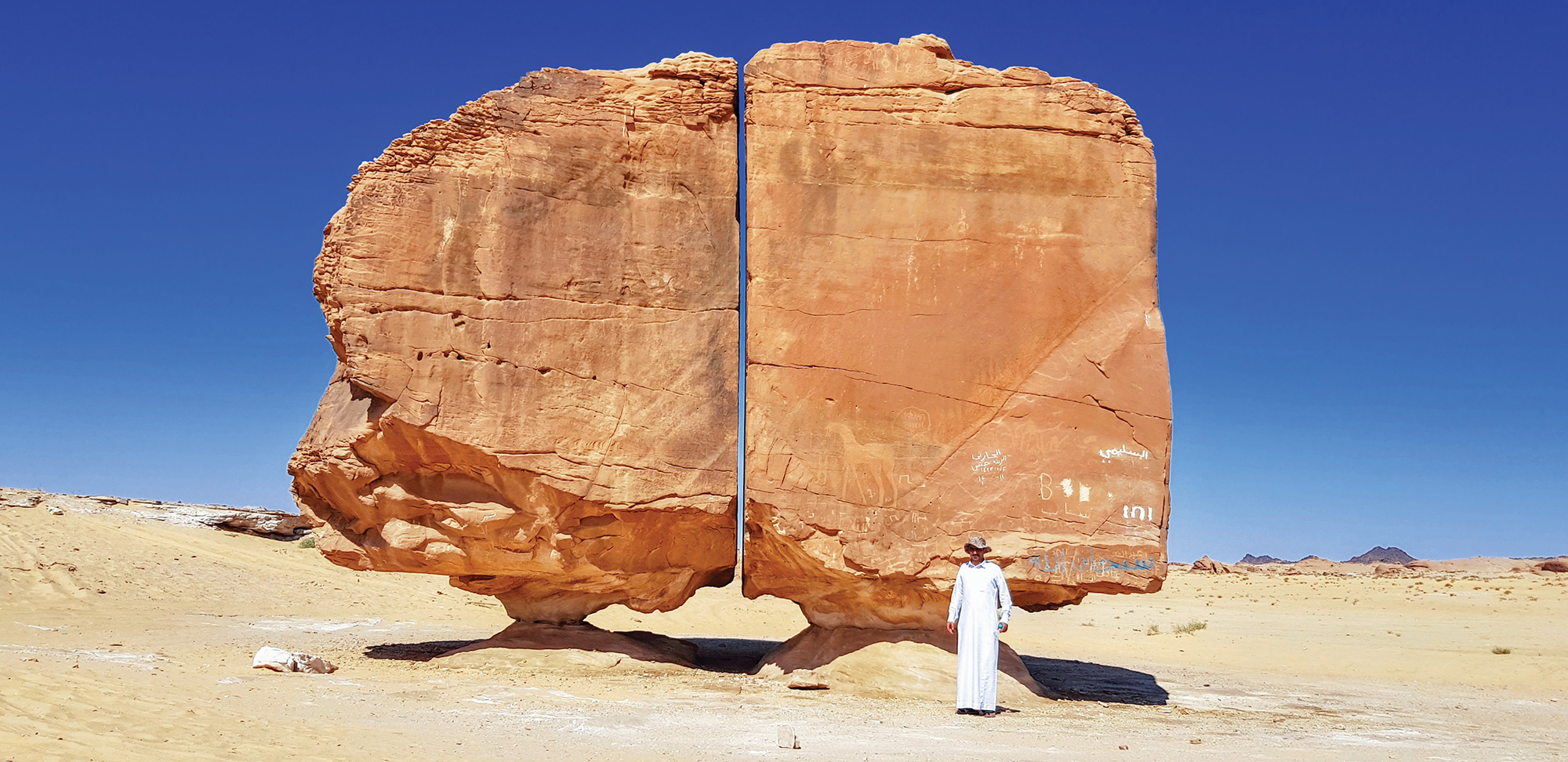
In remote Saudi Arabia, roughly one hundred twenty miles east of the Red Sea, stands Al Naslaa, one of the world’s strangest geologic curiosities. Or, is it actually two? (Perhaps more of a question for geologic philosophers, if such people exist.) Al Naslaa is a sandstone boulder, roughly thirty feet tall and another thirty feet wide, divided neatly in two by a surprisingly perfect vertical split several inches wide. Each side of the boulder is perched on a narrow pedestal of sandstone. When viewed from a slight distance, the boulder (or boulders) appears to be levitating.
Al Naslaa is near Saudi Arabia’s Tayma oasis, one of the earliest known sites of human settlement in the region. The bottom of the rock face is covered in petroglyphs of horses, ibexes, and human figures that may be as many as four thousand years old. The petroglyphs are evidence Al Naslaa has been a cultural draw as long as people have lived nearby. And probably as long
200 words to go
You’re just getting to the good part.
This story — and 42 issues of them — opens with a subscription.
Either one picks up right where you left off.
Join 7,000+ readers · Independently owned · Since 2008
Already a subscriber? Sign in