Mementos, Notes, and Fragments
Snow and Ice Monsters Have Invaded the Ski Slopes of Japan
Nobody does monsters like the Japanese. In the twentieth century, Godzilla ruled popular culture (sorry, Mothra), but there are many more monsters in Japanese lore, hundreds of them stretching back centuries and known collectively as yōkai, from the kamaitachi, a kind of clawed weasel that lives in the mountains, to the tsurube-otoshi, which pounces on its victims from the trees.
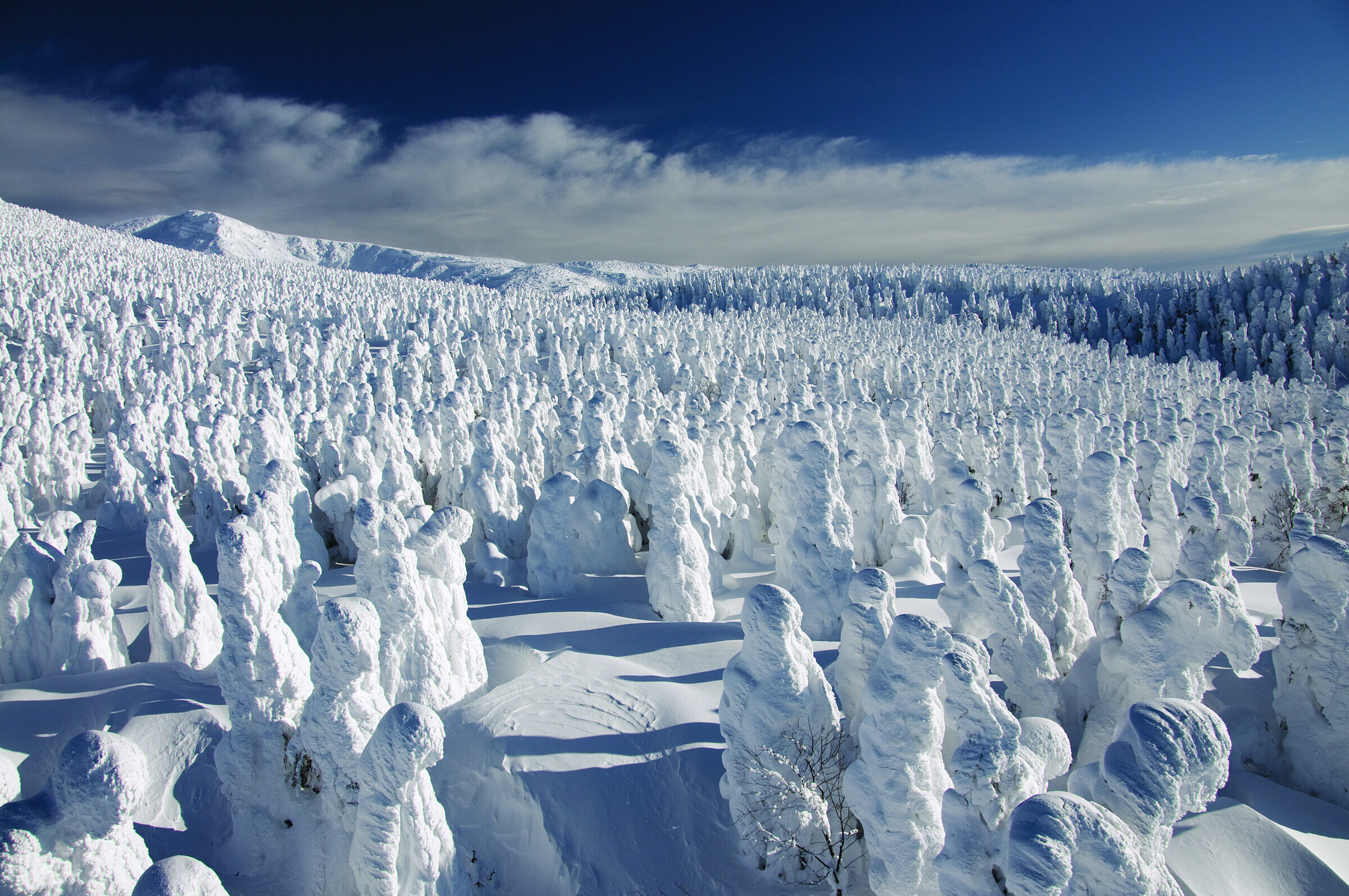
Less feral, and by any stretch easier on the eyes, are the juhyo, or snow monsters, that inhabit the slopes of Mt. Zao, a ski resort in northern Japan. These creatures are nothing more than well-spaced Maries fir trees (Abies maresii) plastered with snow, and for millennia, or as long as weather patterns have brought frigid arctic winds from the west across the Sea of Japan, the trees have stood there crusted in rime from January to March. In recent years, though, they have become a major attraction, with tourists traveling from all over the country to see them, and now the ski resort promotes the juhyo, sells tram tickets to non-skiers, and even illuminates the trees at night to enhance their spookiness (and extend visiting hours).
For this, thank the rime, which occurs when supercooled water vapor hits and immediately bonds to a surface colder than the freezing point, and the wind, which sweeps horizontally across the slopes and sculpts the firs into those fantastical shapes. As with clouds, you can spy all kinds of beings in the juhyo. Visitors have described seeing a Tyrannosaurus rex, a corpulent queen with a crown of antlers, and a baby Yoda sitting on the shoulders of Sasquatch. And while it hasn’t yet been reported publicly, somewhere in that forest of rime there surely must be a Godzilla, king of all monsters, waiting for his next challenger, who will also surely lose.
All Food Is Energy Food, Therefore Cookie Dough Is Also Energy Food
In 2010, Mike Curiak was riding in the Iditarod Trail Invitational, a legendary eleven-hundred-mile Alaskan winter bike race, and wasn’t coming close to getting the calories he needed. Curiak had won the Iditarod in 2000, 2002, and 2005, setting course records each time, and he was used to competing on fumes. (“If I start running low on food, most of the time all I have to do is change my mind—convince myself to eat a lot less, and it ends up working out just fine.”) This time, though, burning eight thousand calories a day and consuming just five thousand led to three weeks of near-starvation.
A year later, that experience was fresh in his mind as he made his last preparations for a two-week bikerafting trip on Alaska’s wild Lava Coast. Thirty-six hours before leaving, inspired by a concoction created by Eric Parsons and Dylan Kentch, who riffed off the idea of another pair of packrafting pioneers, he ran to the “groovy hippy grocery store” and threw together the nuclear option of backcountry foodstuffs.
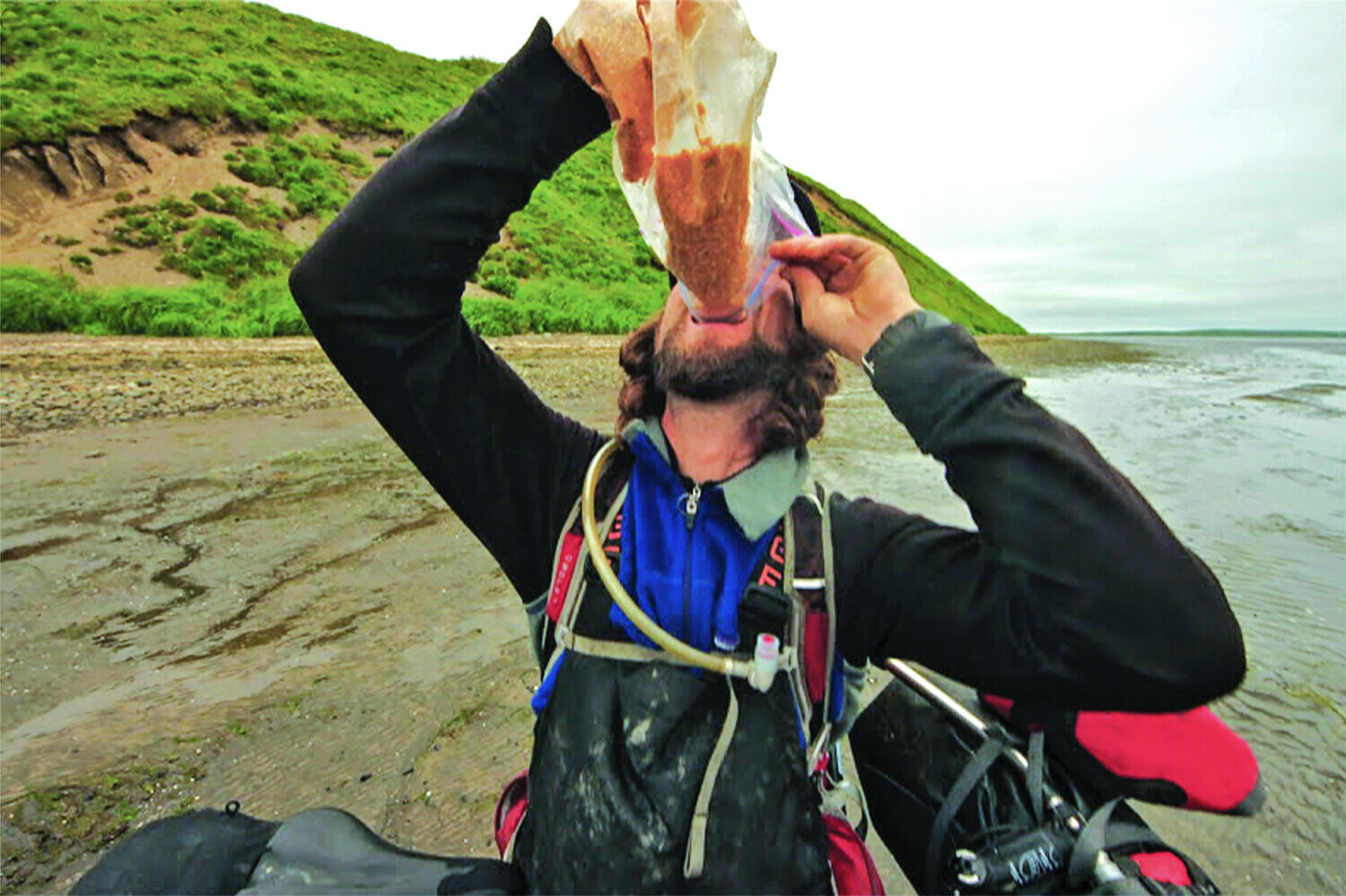
Curiak’s take on backcountry “cookie dough” contains no eggs or flour, but consists of one pound of chocolate chips, two sticks of softened butter, twenty ounces of peanut butter, one pound of brown sugar, and five cups of oats. Throw it all in a giant bowl and stir. Approximate calories: ten thousand. Serves one.
On the Lava Coast trip, Curiak said, “I carried mine in a Ziploc freezer bag and just broke off really effing big chunks whenever the idea popped into my head. Which is to say that I’m ‘always’ in the mood for cookie dough. I brought four pounds thinking it would last me the whole trip. It lasted three days.”
A Study in Blue, Far Above the World
Why is the sky blue? A worthy question, certainly, but eighteenth century scientist and alpinist Horace Bénédict de Saussure also asked how blue is the sky? He’d observed that the color was lighter on the horizon and darker above. What would happen as elevation increased and one drew closer to the sky itself? If you climbed the tallest peaks, would the sky turn black, as legend had it, and then you’d fall into the void?
For de Saussure, this was not idle speculation. He grew up in Geneva in the mid-1700s and from an early age was obsessed with climbing Mont Blanc, looming over Switzerland, France, and Italy and at 15,774 feet the highest point in the Alps, but he was equally compelled by the pursuit of knowledge. At twenty-two, he became a professor and traveled across the Alps performing experiments on heat and cold, on the weight of the atmosphere, and on electricity and magnetism. He invented all manner of instruments and tried to measure seemingly everything that could be measured.
De Saussure attempted to make the first ascent of Mont Blanc in 1774, climbing from the Italian side of the mountain. He tried again in 1785. In 1786, spurred in part by de Saussure’s offer of a reward, a pair of Chamonix men was at last successful, and two years later de Saussure hired them to guide him to the top, along with eighteen porters to carry his instruments.
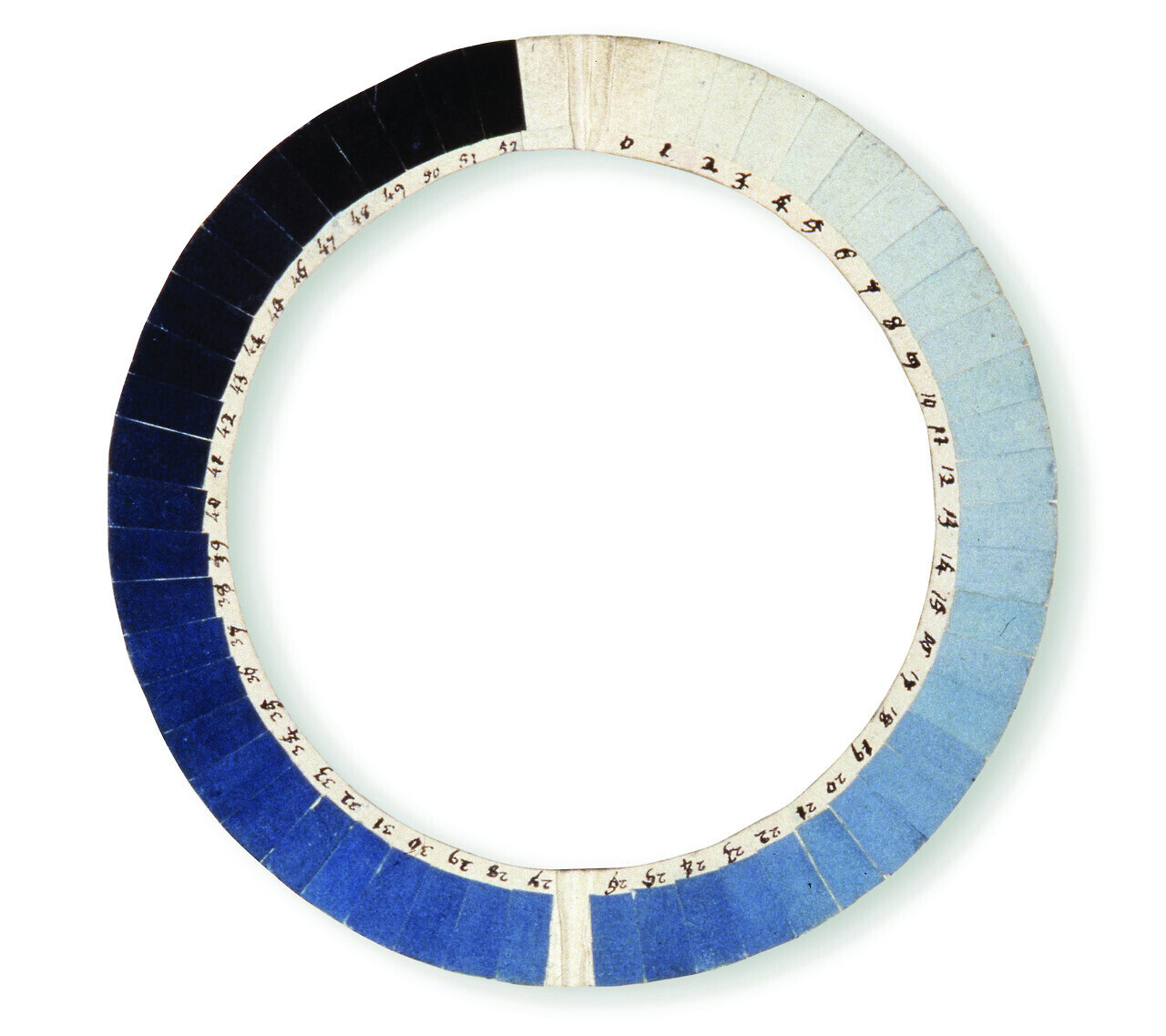
Among them was his solution to measuring “blueness”—a device he called a cyanometer. It was a circle of paper on which he painted fifty-two gradations of blue, from almost white to nearly black. And then on a clear day in the summer of 1787, finally standing on the summit of Mont Blanc, he held his cyanometer above his head and looked through it. With less air to scatter light particles, it was indeed darker than in the valley—the sky was number thirty-nine, in fact, the darkest he’d ever seen, or ever would.
A Frosty Throne for the Kings and Queens of the North
Living the outdoor life leads to answering the call of nature in all kinds of environments, conditions, and temperatures. And from the groovers on Grand Canyon river trips to closet-size outhouses in Canada’s Wapta Icefields to your own privately dug cathole wherever that may be, that call is heeded in some of the world’s most spectacular settings—we’ve even seen a wall calendar that celebrates particularly beautiful locations of adventurey constitutionals.
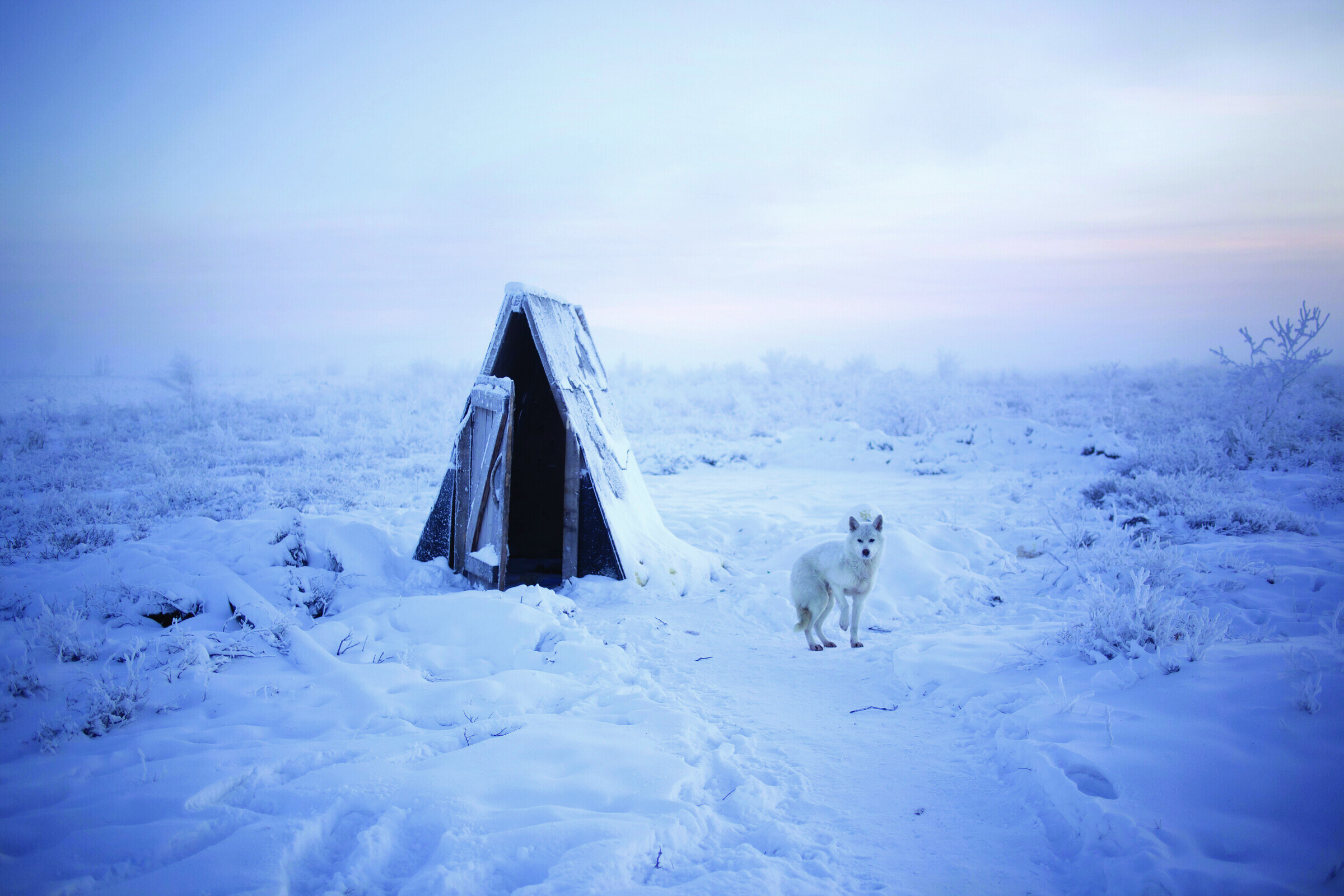
Out of all of them, though, none can touch this tiny A-frame in the Siberian town of Oymyakon, known as the coldest settlement on earth, where the average January low is minus fifty-seven degrees Fahrenheit, for a truly extreme experience.
Photojournalist Amos Chapple, who was born in New Zealand and is based in Prague, is fascinated with cold places and the people who live there, and on his first trip to Oymyakon he photographed one of the town’s stray dogs near this pop-up outhouse, surely the world’s coldest. Indeed, it was so cold the dog was hopping from foot to foot to minimize the time each paw was on the snow.
“Plumbing in the region presents a massive engineering challenge since each summer the frozen ground thaws and shifts. So most toilets are just holes in the ground,” he said. “This one was well used, and I’ll never forget the horror of using it myself. Because it’s usually around minus forty to sixty degrees Celsius there, poo and pee freezes almost the moment it hits the ground. Under the shack, there was a deep hole with a tall, thin stalactite of shit stood like a church steeple in the hole. I’ll never forget that sight.”
Ew. Nevertheless, next time you’re out in the breeze, shivering, think of Oymyakon and remember that no matter where you go, or where you happen to be going, it’s probably a lot warmer than in Siberia.
42 issues. 11 years. Independently owned. Printed on 70lb uncoated paper with a soft-touch cover, solar-powered, and shipped in a brown paper envelope. Free domestic shipping.